Winter is Coming

The television series Game of Thrones warns darkly of a coming winter when cities are destroyed, crops fail and thousands of people die of cold, famine and war. What I intend to explore in this post is the future of our contemporary industrial civilisation and whether we are heading towards an equivalent winter in the coming decades.

To peer into the future the past is often a good place to start. During the 1970’s concerns regarding resource depletion, sustainability and future availability of oil supplies were major issues which were widely discussed in the public sphere. A widely misunderstood group attempted to forecast the future trajectory of civilisation through a computer simulation which calculated the consequences of interactions between the Earth’s and human systems. In 1972 the book Limits to Growth was published with various scenarios including a “business-as-usual” standard model (the “standard model”).

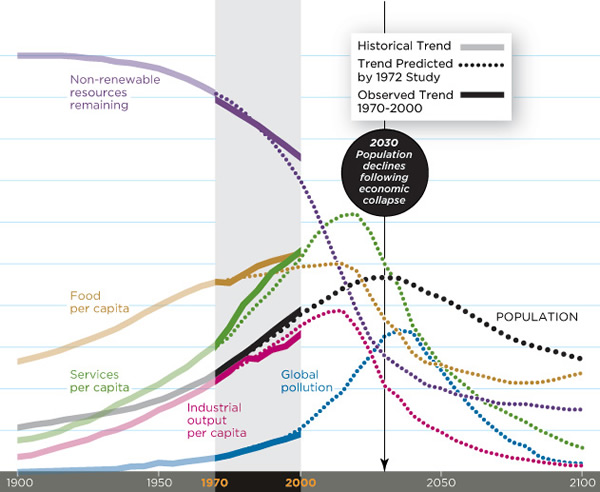
Researchers have regularly revisited the Limits to Growth forecasts in the proceeding decades and the standard model is in line with the real world trends to this current day. You can see the standard model and the 30 year update below. To summarise, a 1972 computer simulation has accurately predicted the major trends of the world economy and biosphere over the last four decades, yet it is hardly known to the general public. The reason why nobody wants to discuss the eerily prophetic Limits to Growth standard model may be in what it forecasts in the future.
 

futurism-got-corn-graph

  • A catastrophic global collapse in industrial output per capita and food output per capita from around the mid 2010’s onwards.
  • A massive ongoing rise in global pollution which only peaks in mid-century.
  • Services per capita peaks around 2020, after which there is a devastating collapse, with a huge drop within 20 years of the peak.
  • By around 2030 the world economy has started collapsing with ominous implications for the world population which starts to drop from that point onwards.

The only minor consolation is that on a number of the key trends, the real world data is marginally better than the forecasts by the computer simulation, although still in line with the overall model. Some may argue that technology will come to the rescue and save humanity from this bleak dystopian future. Although an energy game-changing discovery like cold fusion could avert our likely future, there is no evidence that such a technological savour is on the horizon. If the world of science is going to rescue us, it should better hurry up, as we are running out of time.

Decades ago, there was still time to ensure sufficient non-renewable resources could be preserved for future generations through a shift away from a free trade oriented world economy dedicated to economic growth. It is probably too late to avoid significant negative repercussions as our fossil fuel supplies become scarcer and ever more expensive to mine. Even the spectre of manmade climate change wreaking havoc hasn’t been a sufficiently strong reason to force world leaders away from the business-as-usual status quo. It is highly unlikely that politics can save the world now.

The trends forecast in the Limits to Growth standard model is the mega-trend driving world economic and political forces. One of the reasons why the Pundocracy increasingly fail to accurately predict major political events (for example the Brexit referendum result) is that they have a total blind spot to the biggest mega-trend impacting on the world. Ordinary voters understand at an instinctive level that the prospects of maintaining a middle class lifestyle are dying. When news viewers see thousands of migrants risking their lives to get into Fortress Europe, they sense, that this is only the beginning of a massive migration wave from a collapsing MENA (Middle East and North Africa) region. And they are right.

Based on the standard model megatrend, as well as other key drivers, here is what I anticipate is likely to happen in the coming decades;

  • The eurozone will collapse around 2020

Historically, European monetary union experiments have lasted on average 20 years and the eurozone is the biggest and most ambitious monetary currency union in European history. It is however in profound trouble with openly anti-Euro parties including the French National Front and the Italian Five Star Movement enjoying a real chance of winning power in elections next year. Should either France or Italy vote to leave the Eurozone, the economic and political implications will be devastating.

The European elite have created a monetary and currency union without a corresponding fiscal, banking or political union. If the eurozone is to survive in the long-run, it needs a functioning supranational federal government which can arrange fiscal transfers from the wealthy northern countries to their poorer Mediterranean neighbours. Public opinion polls show no popular support for such a federalist vision amongst the European public. Even without the Limits to Growth megatrend, it was always unlikely that the eurozone would survive the rising populist backlash by an alienated European electorate. The only question is whether the eurozone experiment, inaugurated in 1999, will collapse in an orderly or disorderly fashion.

  • Nationalistic and populist political forces will continue gaining power

The rise of nationalistic and rightwing populist forces throughout the world is gathering pace. Russian strongman President Putin was one of the first but there are many others in power now, including President Erdogen of Turkey and the authoritarian Chinese President Xi Jinging. One could call it the Putinisation of world politics. These charismatic leaders are popular with the masses and appeal to the nationalistic feelings of their peoples.

The virus of Putinisation is spreading to the Western world. Rightwing populist parties have gained power in Poland and Hungary and only narrowly lost in the Austrian presidential elections recently. The Republican candidate Donald Trump, an admirer of President Putin, is neck to neck in the polls against Hilary Clinton and is likely to win the November general election. The election of Donald Trump as president will be a historically significant event and will signal that the liberal international order has died.

  • The return of the State

As we enter into the long twilight years of shrinking and more expensive non-renewable resources, access to oil, gas, coal and rare metals will become a matter of national security. The state will see a comeback as the market will not be relied upon to ensure sufficient supplies of strategic raw materials critical to a modern industrial society.

The writer John Greer has written about this new era of economic decline and growing world disorder, which he calls Scarcity Industrialism, in a number of articles over the years. As Greer notes, the key feature of this new era will be that “access to fossil fuels and other non-renewable resources will be the key to international power and national survival, but by that very token fossil fuels and other non-renewable resources will continue to slide down the curves of depletion. As resource production in one nation after another drops below levels that will support any kind of industrial system, industrial economies will unravel and give way to other forms of economy.”

States that have strong national security regimes and powerful militaries will be in a strong position to ensure sufficient strategic resources to keep their economies afloat. Power will shift from the finance oligarchs to the generals in the coming decades and a frightened public across the world will demand strong leaders who can preserve their crumbling way of life.

  • The international migration crisis will massively worsen

Experts on the refugee and migration crisis warn that Europe faces the prospect of waves of migration which will dwarf the million and a half that have arrived to date. The German government has been warned that up to 10 million migrants could enter Europe within the next 5 years from a troubled MENA world. As food per capita starts to fall of a cliff in the coming decades, hundreds of millions will be at risk of starvation across the African and Eurasian continents. These people will have nothing to lose by trying to enter a prosperous Europe.

The prospect of tens of millions of predominately Muslim Africans and Arabs trying to enter Europe in the coming decades will accelerate the rise of right wing populist forces to power across Europe. Where there are already significant Muslim populations in western European countries, including France, Sweden, Germany, Belgium and the Netherlands, tensions between the Muslim and non-Muslim populations will continue to worsen.

  • The European Union (EU) will collapse around 2030

The likely collapse of the eurozone around the year 2020 will be a hammer blow to the European Project. It will still be in the interests of the major European powers to keep the union going as economic and geopolitical tensions worsen throughout the world. As the forces outlined in the Limit to Growth megatrend worsen, the ability of an increasingly fragmented and divided EU to survive will diminish, and the EU will eventually disintegrate into nationalistic power blocs.

  • Western Europe is heading towards civil war

The prediction that Western Europe is heading towards civil war may appear absurd but it is a frighteningly real possibility. The Chief of the Swiss Armed Forces, Lieutenant General André Blattmann, has publically warned of the risk of civil war, in December 2015. On 12 July 2016, it was reported that the head of French intelligence Patrick Calwar informed the French parliament that France “is on the brink of civil war” between the ultra-right and the French Muslim community. British Rear Admiral Chris Parry warned in the Sunday Times on 11 June 2006 that western civilisation faced a spectre of a Roman Empire style collapse in the coming decades as mass migration and radical Islam triggers violent unrest. European security and military circles are discussing the risks of civil war in public and almost certainly in private.

If there is widespread and violent unrest from a radicalised young Muslim population, then the cities of France, Belgium, Netherlands, Sweden, Denmark, Italy, Germany, Austria and the United Kingdom will bear the bulk of the fighting. Western European states have cut their military and police budgets since the end of the Cold War and would struggle to put down a violent urban uprising. European governments could have to request American military support but it is not certain that a future US president would send US military forces in a European urban insurgency. Hopefully this grim prospect will never happen and the securocrats are wrong in their fears.

To conclude, we are entering into a twilight era of Scarcity Industrialism where the current financial, economic and geopolitical framework is disintegrating. The Limits to Growth megatrend is driving a collapse of the post-Cold War liberal international order, which will be heralded when Donald Trump is likely inaugurated as America’s next president on 20 January 2017.

Winter is Coming

Et tu, Gove?

The extraordinary political assassination of the front-runner Boris Johnson by his campaign chief Michael Gove, is by any standard, the most stunning political betrayal in modern British history. The Justice Secretary Micheal Gove has spoken over the years that he would never run for the leadership of the Conservative Party. My prediction that Boris Johnson would succeed in defeating Theresa May in the Conservative Party leadership election rested on the assumption that Michael Gove would align himself with the Johnson campaign. 

Now that Michael Gove has unexpectedly become a candidate in his own right, the race for the leadership has been blown open. Boris Johnson’s withdrawal has inevitably made void my prediction of a Johnson victory and is a lesson that there are no certainties in politics. The Home Secretary Theresa May is a formidable and savvy political operator and is in a strong position to win the race. May’s biggest weakness is her timid support for the Remain camp which will do her little favour among the pro-Brexit grassroot activists. 

Michael Gove and the rising star Andrea Leadsom are in a battle for second place in advance of the final vote of the MP’s tomorrow. Whoever succeeds in rallying the pro-Brexit forces to their flag will be in a strong position as the race branches out to the 150,000 strong Tory membership. The only aspect of this race which I will state with any certainty is that Theresa May is not guaranteed to win amongst the membership who overwhelmingly backed the Leave cause. 


Et tu, Gove?

Implications of the Brexit triumph on the US presidential election

The decision by the British people to leave the European Union has stunned the world and has major implications for the US presidential elections, scheduled on 8 November 2016. The media and political elites (the “Pundocracy”) in the United States have dismissed the chances of the presumptive Republican candidate Donald Trump winning the Presidency.

The truth is quite different. Donald Trump, an instinctive politician, sensed the mood of the American electorate which is angry, frustrated and ready for an outsider to smash the failing status quo when he launched his insurgency campaign in June 2015. What the Brexit result signifies is that the working and middle classes are in open revolt and will not be intimidated, bullied and silenced by the political and economic elites on either side of the Atlantic.

Political experts agree that Donald Trump needs to win the Rust Belt states like Pennsylvania, Ohio, Michagan and Wisconsin if he has a realistic chance of defeating Clinton. Reports are indicating that Trump could do very well in these states and Hilary Clinton hasn’t connected with the concerns of blue-collar voters. The Pundocracy are underestimating the anger among the American people and the real levels of support for Trump outside the Beltway. Just as a “shy Brexit” phenomenon contributed to the victory of the Leave campaign, the pollsters haven’t factored into their models the potentially 4% of the electorate who are “shy Trump” voters, who could swing the election.

The firing by the Donald of his top aide Corey Lewandowski on 20 June will be considered by future historians as a key turning point in the Trump campaign. Lewandowski encouraged a “let Trump be Trump” strategy that worked well in the primaries but has backfired with the broader electorate. The experienced and ruthless political operator Paul Manafort is now in charge of the Trump campaign and will direct the pivot towards a more “presidential” Trump.

Donald Trump has seen a sharp drop in the national poll ratings recently with the average poll of polls showing that he is 6% behind to the presumptive Democratic candidate Hilary Clinton. This was triggered by ill judged and inflammatory comments about the Mexican heritage of a judge investigating the Trump University law suit which has amplified wider concerns about whether Trump is fit to be president.

Trump will need to deal with this toxic issue head on if he is to gain traction among minority voters and independent voters. Trump, contrary to what some in the Pundocracy appear to think, is not a stupid man. He is fully aware of the need to adopt a more serious, sober and “presidential” campaign and the firing of his closest aide Corey Lewandowski shows that he now “gets” the importance of the general election pivot I have written of before. The Republican Convention at Cleveland will be a key moment in reshaping perceptions of Trump and challenging the view that he is a racist buffoon.

As long as the Donald stays with the playbook outlined by Paul Manafort and pushes his powerful anti-establishment, inclusive and economically populist agenda with the wider American public, than he will be on course for a historic victory on 8 November 2016.


Implications of the Brexit triumph on the US presidential election

The post Brexit fallout

The unexpected victory of the Leave campaign in Thursday’s referendum on Great Britain’s membership of the European Union has already caused massive political and financial disruption. Here is my take on what to expect in the coming months;

  • The Conservative Party has been deeply divided on whether to remain in the EU and it will take years for these divisions to heal. The 1922 Committee has agreed to a quick leadership race with a new leader to be elected by early September. The leading Leave politician and former London Mayor Boris Johnson is the favourite to win the race and is popular among the notoriously Eurosceptic party membership.  The Home Secretary Theresa May is likely to be his main opponent even through she backed the Remain campaign. I predict that Boris Johnson will be elected the Conservative Party’s next leader.


  • The Labour Party is in the process of implosion with the bulk of the parliamentary Labour Party (PLP) in open revolt against their veteran socialist leader Jeremy Corbyn. It remains to be seen if Corbyn will be automatically added to the leadership ballot or whether he will need to gain the support of 20% of the MP’s and MEP’s in order to stand as a candidate. Should the Labour leader automatically be a candidate in the upcoming Labour leadership race, it will be hard to defeat him, as he still enjoys significant support among the wider Labour activist membership. Should Corbyn manage to get on the leadership ballot, my prediction is that he will narrowly win the Labour Party leadership election.


  •  Assuming that Jeremy Corbyn survives the challenge to his leadership, a number of fatal consequences will follow for the party. It is likely that the centre-right MP’s within the PLP will formally split from the Labour Party and create a new centrist political group which will be closely aligned with the Liberal Democrats. A vengeful hard left within the Labour Party, in alliance with the trade unions, will start deselecting anti-Corbyn Labour MP’s and replacing them with Corbynistas.


  •  Assuming that the above scenarios come true, it is a real possibility that a Boris Johnson led Conservative government will trigger an early general election before the end of this year to gain a popular mandate and exploit the chaos in the Labour Party. I would anticipate that the Tories will gain seats at the expense of Labour and secure a 100 seat majority. However, there are real risks of triggering an early general election and whoever is elected the next Tory leader may decide to get on with negotiating the exit of the EU.


  • A consensus is emerging within the Conservative Party that the best interests of the country is a “soft Brexit” where Britain will keep access to parts of the single market in return for some controls over EU migration. It is not quite the total control over immigration promised during the referendum campaign and UKIP leader Nigel Farage will exploit this. The cry of betrayal by UKIP will be felt strongly in working class Labour heartlands where the issue of immigration is such a hot topic. UKIP will exploit this cleavage at the next general election and should the Labour Party leadership not oppose a “soft Brexit”, Farage’s UKIP will perform well in the north on their “hard Brexit” platform.


  • There is much talk among the Pundocracy about a second Scottish referendum on independence. Although there is much anger among the Scottish electorate, who voted for Remain by a substantial margin, the weaknesses of the Scottish independence campaign hasn’t changed. Indeed, it has got far worse. The oil price has collapsed, North Sea is dying and the fiscal deficit has grown to £15 billion. Once passions have cooled, it is likely that older Scottish voters, who voted for the union out of fear of their state pensions, will grudgingly stay within the union. Should Scotland’s First Minister Nicola Sturgeon decide to take the greatest gamble of her political life, it will be within the next two years, before Britain exits the EU. A second Scottish referendum is a possibility and it will likely happen only if opinion polls show sustained lead for independence over a minimum of six months.


The post Brexit fallout

Britain votes to leave the European Union

The British public has narrowly voted to leave the European Union with Leave on 51.9% and Remain on 48.1%. The victory for the Leave campaign is a massive repudiation of a complacent and arrogant political and financial establishment.

For those who have been following my blog this result should not come as a shock as I predicted a narrow Leave victory in my first post in January 2016.

I will write a more comprehensive post on the impact of the Leave vote in due course but the result will certainly have a profound impact on the future of the European Union.


Britain votes to leave the European Union

Can the Brexiteers pull it off?

After months of, at times, rancorous debate Great Britain is in its final stages on the referendum on whether to stay in the European Union (EU) scheduled on 23 June 2016. The Remain camp has massive advantages with the bulk of the political, trade union and City establishment backing the case to stay in but they have failed to “seal the deal” with the British electorate to date.

Prime Minister Cameron has pursued a similar strategy to the Scottish Independence referendum campaign, with a focus on the economic risks of leaving the EU, known to its critics as Project Fear. The Treasury, Bank of England and the major finance houses have all piled in with dire warnings of the impact of a Brexit vote with little or no impact on the opinion polls. If anything, the general public, if the current opinion polls are correct, are increasingly leaning towards Brexit.

In my opinion the major reason why the Remain camp are not doing as well in the polls as expected is primarily over-egging the economic risks of leaving in the EU. When the Prime Minister warns of World War 3 or a global recession if Britain votes to leave he damages his main asset; his credibility. The Remain camp are right to raise the risks of leaving the EU but it should be done in a balanced way which doesn’t insult the intelligence of the British public.

In my last commentary on the Brexit campaign, I noted that the addition of Michael Gove and Boris Johnson gave the Leave side a fighting chance of winning the referendum. Although Boris has had a troubled campaign to date, Michael Gove’s impressive performance during the recent studio debate shows what a strong asset he is to the Leave camp. Gove brings a seriousness and intellectual credibility to the Leave argument which may prove critical in persuading Tory-leaning floating voters to voting Out.

If the referendum campaign was a marathon then the Remain camp was supposed to out-sprint the Brexiteers doing the months when the full force of the Government machinery could be utilised to bombard the British public of the dire risks of leaving the EU. The Leave camp have survived this most deadly phase of the campaign with their support base intact.

Now, the Leave camp have started to utilise their trump card, immigration, in the final weeks of the campaign. Immigration has regularly appeared as one of the biggest concerns of the public for years and the majority of voters think that voting to leave the EU will help Britain control the flows of EU migrants into the UK.

Whilst the international refugee crisis has been relatively quiet over the past few months, now that the seas are warming up, we are starting to see thousands cross the Mediterranean every day from the shores of Libya. These pictures are being beamed into millions of British homes every night. Should ISIS succeed in attacking Euro 2016 in the coming weeks this could also have a major impact on the campaign.

Ultimately, the result will come down to the perceived economic risks of leaving the EU versus the cultural identity and security concerns of staying within a club which will allow unprecedented future migration into the country. Which is considered a more vital issue for the floating centrist voter will decide the outcome.

It is impossible to say with any degree of certainty how the public will vote on 23 June 2016 and both sides have a fighting chance of winning the referendum as we stand. I would not be surprised however if we wake up on the 24th June to discover that a slim majority have voted to leave out of a determination to gain control of Britain’s borders and its future.


Can the Brexiteers pull it off?

Angela Merkel losing popularity in Germany

In my predictions for the year 2016, I predicted that because of the controversy caused by Angela Merkel’s “open door” policy towards refugees, an attempt would be made to topple her from power this year.

A recent opinion poll published in Germany reports that a staggering 64% of Germans sampled do not want Angela Merkel to run as chancellor next year. The majority of German public opinion has turned against her decision to welcome hundreds of thousands of refugees in 2015. Whether hard-line conservative factions within the ruling party will attempt to remove Angela Merkel from office this year remains to be seen, but it is clear that the German Chancellor has lost her Teflon touch with the German public.

Evidence that ISIS have used the migration crisis to infiltrate terrorists into the heart of Europe continues to grow, with German police currently investigating 40 potential terrorist cases. As many of the migrants who arrived in Germany last year did not have identification papers, it is impossible to know for certain how many terrorists ISIS have managed to infiltrate into those countries in Europe that accepted refugees.

The European intelligence services are in a race against time to prevent a terrorist attack against innocent civilians and I certainly hope that my grim prediction of a multi-state jihadi terror attack this year does not come to pass. The horrifying Brussels attacks show the capability of these jihadi terror networks and it is unfortunately a strong possibility that more attacks will come later this year.


Angela Merkel losing popularity in Germany

Republican elections: Game, set, match

The Republican presidential candidate Donald Trump crushed his remaining rivals in the Indiana primary elections on 3 May 2016 winning 53% of the vote. The landslide result forced his chief rival Senator Ted Cruz to suspend his campaign, effectively ensuring that Donald Trump will be the GOP presidential nominee in the 2016 presidential election.

For those who have been reading my blog I predicted that the Donald would have wrapped up the Republican nomination by early May in my article ‘Donald Trump – Cruising towards victory’, dated 23 February 2016. What the Donald has achieved is affectively a hostile takeover of the Republican Party by the populist-nationalist wing of the Republican coalition.

By wresting control away from the traditional elite party grandees and the superrich donor class, Trump now has the opportunity to remake the party as the champion of the American working and middle classes. The conventional wisdom is that Donald Trump is unelectable and will be slaughtered by the centrist establishment figure Hilary Clinton. On the contrary, I argue that as long as Trump moves firmly into the “populist centre” of American politics and reassures independent voters that he is ready to take on the responsibilities of the office of the presidency, he is in a very good position to defeat Clinton in November.

The world is transfixed by the US presidential election and watch with growing horror, disbelief and amazement as the Trump juggernaut gets ever closer to the White House. What would a Trump presidency mean for the United States and the world? I intend to try and answer these questions in a future post soon. The only thing for certain, should Trump win the presidency in November, is that it will be a world-historical event with global implications which will reverberate for decades to come.

Republican elections: Game, set, match

The return from the dead of the Donald

After the trouncing of the Republican presidential candidate Donald Trump in the Wisconsin primary election on 5 April, many in the media and political elites (the “Pundocracy”) hailed the result as a key turning point, indeed, “Peak Trump”.

The defeat in Wisconsin came after a series of self-induced blunders by the Trump campaign and the scale of the defeat has led to significant changes to his message discipline, the tone of his campaign, well as the appointment of key professional advisers to Team Trump. The salient fact is that Trump recognizes the need for change, has adapted his campaign and has appointed the right people on board to secure a majority prior to the Republican Party’s Cleveland convention in July 2016.

In my most recent blog article on 20 March, I predicted Donald Trump would win the majority of the delegates and avoid a contested nomination in Cleveland. The defeat in Wisconsin, contrary to the conventional wisdom, will lead to the securing of the Donald’s nomination as the Republican presidential candidate.

The victory of Trump in his home state of New York, with over 60% of the vote, was a strong comeback for a candidate who had supposedly peaked weeks ago. One of the most interesting aspects of his victory was his appeal to Republican Latino voters, whom he won over 50% of the vote. We have already seen his success with Latino voters in the Nevada primary election, where he won half the Latino vote, even when competing against two Latino Republican candidates.

I have always argued that Trump, once he starts pivoting to the populist centre, will gain traction among minority voters who will find his core economic message appealing compared to the stuffy and wooden establishment figure Hilary Clinton. Of course, Trump is not going to get a majority of minority voters support, or anyway near that, but he only has to do as well, or better, than previous Republican candidates to get into the White House.

The main argument of the Pundocracy on why Trump can’t win the general election is that his negative ratings are worse than Clinton’s. What this perspective totally fails to understand is that the Trumpian Great Pivot into a serious, substantive and presidential candidate will drive those negative ratings down over the rest of the year. The main concern of many voters is the perception is that Trump isn’t ready or doesn’t have the temperament to be president. Acting and behaving “presidentially” will be the main antidote to that worry. The bottom line is that Clinton’s high negative ratings have been formed over a political career lasting 25 years whilst Trump’s ratings have been formed over less than 8 months. Trump can and will overcome these weaknesses in a way that Clinton simply cannot.

There are signs that the Pundocracy are starting to recognise this reality. On the BBC This Week programme, the former Labour London mayor predicted that Trump will defeat Clinton in November and other news media articles suggest that world leaders are starting to seriously prepare for a Trump presidency. It is still possible that Trump’s presidential campaign will self-implode, but the most likely outcome is that Donald Trump will be America’s next president.

The return from the dead of the Donald

Update – Trump on course for a majority

The conventional wisdom, as articulated by the political and media elites (the Pundocracy), was that Donald Trump’s presidential campaign was a political joke. They were wrong on that.

The Pundocracy than proclaimed that the Donald’s campaign would inevitably implode after a few months, like previous populist outsiders during the Republican primaries. They were wrong on that.

After Trump’s controversial call for a temporary ban on Muslim migration into the United States was announced, the Pundocracy lined up to announce that Trump had just killed his political campaign. Again, they were wrong about that. In fact, a majority of Republican voters and a plurality of the general public supported his proposal.

The Pundocracy, in the face of the sustained success of the Donald, took the view that he had a limit of voters support of 35%. This particular conventional wisdom was blown out of the window during the Nevada primary election, when Trump won with 45% of the vote.

The Pundocracy had also decided, that it was politically impossible for Trump to get any kind of electoral traction with minority voters. This conventional wisdom, albeit on a statistically small scale, was knocked off course when Trump won nearly half the Republican Latino vote, against two Latino opponents!

Now, the new conventional wisdom is that Donald Trump won’t get the majority of the delegates required to avoid a brokered convention, where the GOP elite may trip to stop him becoming the Republican party’s candidate. I predict that this conventional wisdom, like all the others, will be proven wrong in the coming months. Trump will likely start getting close to, and even surpass, the 50% support in the remaining Republican primary elections and will get the majority number of delegates required by the time the Republican Convention begins.

Of course, the greatest conventional wisdom bubble still in existence, is the idea that Trump does not have a realistic chance of defeating Hilary Clinton in November. I will discuss in a later post how he will go about defeating the Democrats, however, to sum it up, Trump will aggressively pivot to a new populist centre of American politics where opinion polls show the majority of voters are. This means protecting Social Security, Medicare, taking a sceptical stance on foreign wars, tax rises for the superrich, reforming Washington and the special interests and taking a more aggressive approach to free trade deals and off-shoring by US companies.


Update – Trump on course for a majority