The French Rubicon

On 49 BC, the great Roman general Julius Caesar faced a choice, cross the river Rubicon and march on Rome or not. He chose to cross the Rubicon with the full knowledge that his action would provoke a civil war in the Roman world.

The French electorate face a similar moment in their country’s history on April and May 2017 when the two rounds of the presidential elections are held. The centre-left and centre-right political parties are deeply divided on how to overcome the multiple challenges facing the French state; a serious domestic Islamist terrorist insurgency, a stagnating economy with shocking levels of unemployment and the decline in the power and international influence of the nation in the EU and the world.

Nicholas Sarkozy, the divisive and unpopular former president, has formally declared his intention to run for the presidency again. Sarkozy has moved to the hard right with ultra-hawkish positions on how to deal with the rising jihadi threat. The Republican Party candidate has proposed the indefinite internment of known extremists, the shutting down of mosques and the ending of the EU rule of family unification for migrants who have settled in France.

Sarkozy enjoys the support of the right-wing faithful in the conservative opposition and has clearly gambled that a Trumpist campaign based on identity, security and the cultivation of a “strongman” image will secure victory in the Republican primaries race. Sarkozy has expressed Eurosceptic sympathies with a specific focus on restoring migration controls but is committed to the euro. Sarkozy’s rival, Alain Juppe, is a popular, technocratic and centrist establishment figure who is considered more likeable by the population according to opinion polls. Juppe, a former Prime Minister, belongs to a rapidly shrinking political centre in France but is perceived to be part of the ancien régime.

The outsider and anti-establishment candidate, the National Front leader Marine Le Pen, is expected to get to the second round of the presidential elections. The National Front (“NF”) was an openly fascistic party under the previous leader and father of Marine, Jean-Marie Le Pen. Marine Le Pen has expelled her anti-Semitic father from the party and moved the NF to the populist right-wing and nationalistic political ground. After the horrifying “summer of terror” attacks, Sarkozy and Le Pen exist on a similar hard-right political space when it comes to Islamism.

Le Pen has championed a French withdrawal from the euro and the EU, Frexit, as a key signature policy of the NF manifesto. The French populace have historically favored a strongly statist and protectionist approach to French industry and the NF have captured the bulk of the working class vote with their protectionist economic policies. Polls show the French public have become deeply disillusioned with the European project and only a narrow majority would vote to stay within the EU. 

I consider the presidential elections a critical juncture, not only for the French but for the rest of Europe, as the implications of a shock victory by Marine Le Pen will shake Europe to its foundations. For those readers who wish to read my forecasting prediction on the outcome of the French presidential elections, they will have to wait to the beginning of 2017. However, my indicative thoughts are that Sarkozy is in a strong position to win the Republican primaries in November on a full blooded promise of total war on jihadi extremism and become the next president of France.

Alternatively, Marine Le Pen could succeed in defeating her second round opponent by linking the core issue of security with the wider sovereignty questions which comes from being a member of the euro zone and of the EU. A NF campaign of “taking back control” from Brussels on industrial strategy, protectionism and border security could be a compelling cocktail for a frightened, angry and disillusioned French electorate. Marine Le Pen’s best chances of entering the Elysee palace is by connecting in the minds of the ordinary French voter that regaining sovereignty from Brussels is indispensable to successfully crushing the threat posed by militant Islam.

Much can happen between now and the presidential elections in spring 2017. Further jihadi terror attacks in Europe or the election of Donald Trump on 8 November 2016, both predicted by me at the beginning of the year, could strengthen the forces of the hard right. The French electorate may prefer the experienced ex-president Nicholas Sarkozy to the untested Marine Le Pen with a still toxic fascistic and anti-Semitic legacy.

My gut instinct is that the key voters who will swing the election are older French voters who are terrified of the future and are desperately looking for a leader who can save their country from a looming civil war. Should sufficient numbers of these voters turn to Marine le Pen than the self-styled Joan of Arc of France could narrowly defeat her opponent in the second round of elections.

The world awaits whether the French will cross their Rubicon next year.

The French Rubicon

Book review of John Michael Greer’s Twilight’s Last Gleaming

Twilights-Last-Gleaming-cover

The author and writer John Michael Greer has written a superb novel called Twilight’s Last Gleaming which is set in the near future. In this fictional but frighteningly realistic future reports come in of a huge oil discovery of the coast of Tanzania. What happens next is a chain reaction of events, grippingly written by Greer, as the Americans step in to remove the pro-Chinese Tanzanian government and get their hands on the prized oil reserves.

Unfortunately for the Americans it doesn’t go to plan. The Chinese take advantage of the Achilles heel of the American military, its dependence on its vulnerable aircraft carrier fleet, to devastating effect which leads to the defeat of the American military.

Without giving too much of the story away, what follows next is a political and economic crisis within the American heartland which shatters any lingering respect for the governing class in Washington among the general public.

Events considered unthinkable rapidly become very real as the future existence of the United States itself becomes a matter of debate. The parallels with the current US presidential election are striking, as the governing elite have repeatedly dismissed the political chances of Donald Trump, who has succeeded against all the odds to become the Republican candidate. The unthinkable seems to be happening with greater regularity in our politics these days.

Greer has written a masterpiece of fictional writing which explores the massive challenges facing the United States and the possibility of a military clash with a rising Chinese power at some point next decade. The prospects of a Chinese victory in such a clash are far higher than the military planners in Washington would want to admit.

If you find the themes outlined in my post “Winter is coming” fascinating, then I would strongly recommend that you buy Greer’s novel, as it is a great introduction to the looming world of Scarcity Industrialism we are entering into.

Book review of John Michael Greer’s Twilight’s Last Gleaming

Probabilistic update analysis on my 2016 predictions

Probabilistic analysis is the calculation of the probability of a certain prediction coming true within a set time frame. I intend to do the same with the predictions I set out at the beginning of the year with the intention of being able, at the end of the year, to give myself an overall success score on my forecasting.

I also intend to use this opportunity to update the reader on my current thoughts on each of the predictions outlined;

  • Donald Trump will become the GOP candidate and will defeat Hilary Clinton in the Presidential election.

Donald Trump GOP candidate – 95% probabilistic chance

Donald Trump winning GE – 70% probabilistic chance

The first part of this prediction that Donald Trump will become the GOP candidate has already come to pass. Because of this, I can only be as honest as possible with the probabilistic ratio at the time that I wrote down that prediction. I was always convinced that Donald Trump would do very well in the primary season and overcome any competition from the crowded field of Republican candidates.

I also think that on a balance of probability Donald Trump will still go on to defeat Hilary Clinton at the general election in November. Trump has adapted his campaign and more importantly his tone since the Khangate debacle with a softer, more rounded and presidential approach. The national security round table meeting at Trump Towers, the tour of the victims of the flooding and the series of key speeches on economy and foreign policy all indicate to me that Trump has listened to his advisers and has responded accordingly.

The appointment of the Breibart News executive Steve Bannon has been widely misunderstood by the Pundocracy.  Bannon will sharpen, develop and enhance the anti-establishment, economically populist and “change agent” message of the Donald versus a status quo Hilary Clinton. Trumps outreach to African-American voters fits into this broader rallying of 75% of Americans who feel that America is going the wrong way and are looking for a candidate who can challenge the status quo in Washington. If Trump can harness the latent populist forces in the electorate to his advantage he will go on to defeat Clinton.

Although it is clear that Trump is behind Clinton in the polls, for a number of reasons, I consider the current polls unduly flattering to Clinton. Why is it that the online polls tend to be better for Trump than the phone polling samples? I suspect that the online polls are capturing some of the Shy Trump phenomenon which is a definite if unquantifiable factor at play in the electorate. I have attempted to place the Shy Trump Supporters factor at 4% of the electorate but this is at best an educated guess.

The other question mark is whether the poling agencies are capturing the voters who never normally vote in general elections but intend to in this presidential election. These “once in a generation” voters may have only last voted in November 1980 when Ronald Reagan roared to power on the back of an unprecedented surge of support from blue collar voters. The Brexit referendum saw a surge in turnout from working class sections of the populace who never normally vote in a general election and were missed by the polling agencies who predicted a narrow Remain vote.

My conclusion is that if Trump carries on the path he is following he will be on course to win on 8 November 2016.

2) Britain will vote (just) to leave the EU

Britain voting to leave the EU – 60% probabilistic chance

I bet only a small amount of money on a Leave victory because I always thought it would be a very close result although my gut instinct always felt that Leave would win. Because of this, my probabilistic chance of Brexit was never a strong one, with 60% my forecasting probability prior to the referendum day.

3) Civil unrest in Germany major cities by migrants

Civil unrest in Germany cities by migrants – 50% probabilistic chance

Although we have seen isolated and regular attacks on migrant centres, particularly in the former East Germany, no major outbreak of violence has erupted across Germany, yet, between migrants and far right protesters. There are clearly rising tensions, fuelled by the horrific “summer of terror”, between migrants and locals but so far peace has reigned.

I would place the possibility of major civil unrest at a 50:50 probability as the social pre-conditions are in place but whether the power keg will explode this year remains open. Should violent protests erupt, I would not be surprised if it starts in the economically impoverished towns and cities of the former East Germany, where anti-refugee sentiment is very strong.

4) An attempt will be made to remove Angela Merkel from office

Attempt to remove Angela Merkel from office – 55% probabilistic chance

The Bavarian Prime Minister Horst Seehofer has been a fierce critic of Merkel’s open door policy towards refugees and has threatened to break with party unity and run a separate campaign in next year’s elections. Should Seehofer actually go through with this threat, the pressure on Merkel to withdraw from running for the re-election as chancellor would be overwhelming. It would be a de facto coup d’état against Chancellor Merkel.

The reason I don’t consider this a high probability event is the remarkable Teflon abilities of Merkel to survive repeated political crisis’s which would have sunk other politicians. It is possible that a massive ISIS terror attack this autumn might finally destroy her political authority and embolden her conservative critics to move against her.

Whether Frau Merkel’s luck finally runs out this year remains to be seen.

5) ISIS will launch a multiple urban European terror attack

European 9/11 – 75% probabilistic chance

To a certain extent, the attacks by ISIS terrorists in France and Germany this summer are remarkably in line with my prediction of orchestrated terror attacks in different West European states. The Nice terror attack, shortly afterwards followed by the axe attack on a Bavarian train and the suicide bomb attack in Ansbach were closely coordinated attacks within a short time horizon.

There are important differences, as I anticipated simultaneous attacks on a much bigger and more horrifying scale than what we have seen during the “summer of terror” so far. The security experts refer to it as a “European 9/11”.

It is with regret to say that I still think that there is a high possibility that such a multifaceted attack will come later this year.

30.08.16 – Following feedback, I would like to add the following comments on my predictions;

  • The time frame for all of my predictions are set to expire on 31 December 2016.
  • Regarding a “European 9/11”, I would clarify that this would involve major terrorist attacks (with at least 50 people dead and more injured) in at least two European states within the same day.
  • With respect to my prediction of civil unrest in Germany, for this prediction to be triggered, there would be major riots/civil unrest in at least 5 German towns within a 2 week timeframe.
Probabilistic update analysis on my 2016 predictions

The Donald Trump enigma and the future of Trumpism

Why don’t we enter a time machine back to 25 July 2015? Donald Trump, the joke candidate, has recently announced his presidential campaign which is expected to politically self-implode well before the primary election season starts in 2016. If you had informed a well heeled member of the Washington Pundocracy that Donald Trump would storm the Republican primaries, winning an unprecedented 13 million votes, he would have looked at you as if you were insane.

If you went on to say that in 12 months time, the Republican Party would have formally nominated Donald J Trump as their official candidate at their convention and that the respected political analyst Nate Silver was predicting that Donald Trump would defeat Hilary Clinton if the election was held on 25 July 2016, he would have laughed uproariously. The thing is that all of the above is true.

The reason I have posited such a scenario is to remind the readers just what an extraordinary achievement Donald Trump has accomplished by becoming the GOP nominee. The experts have dismissed his chances at every stage of the presidential election cycle which is worth remembering when discussing the latest predictions of his political demise.

To use a motoring analogy, Donald Trump accelerated out of the Cleveland Convention with a clear run towards the finishing line as he passed the crippled but dogged Clinton car. Instead of pressing the floor down and heading down the motorway, Trump suddenly swerved left and crashed straight into a truck being driven by the Khan’s. I refer of course to the incident when Trump started a twitter war against the Khan family which escalated after he insulted the mother of a dead American Muslim war hero (“Khangate”). Trump’s poll ratings have since collapsed.

The usual suspects within the Pundocracy are gleefully reporting that Trump is finished. There is no doubt that Trump has made a massive error of judgement and has been damaged by the whole Khangate affair. How he responds to the crisis is critical to whether he can recover and go on to win on 8 November.

Across the Western world, social democracy is dying and populist parties are on the rise.  The political sweet spot right now is populist centre-right politics that responds to the multitude of crises impacting our Western societies. Traditional centre-right parties who have dismissed “populist” concerns on immigration, refugees, growing income inequality and the antics of the financial elite have been hammered in the election booth to the benefit of the populists. Where centre-right politicians have succeeded is in utilising the language of anti-establishment populism and responding to and adjusting their policies in the wake of wider public concern on immigration, border security and economic insecurity.  Although it is early days the new Conservative Prime Minister Theresa May has cleverly adapted to the new politics of populism.

Donald Trump is a political outsider who has aggressively used political populism to takeover the Republican Party. What Trump needs to do if he is to win over Middle America is to convince the electorate that he is a serious, credible and substantive candidate with governing centre-right solutions to the many problems facing the United States. The general election pivot away from aggressive populism into that centre-right space will be sufficient to win over enough independent voters to win the general election.

The enigma of Donald Trump is whether he is capable or willing to undertake such a shift in his approach, strategy and style with only three months to go before the election. The majority of Americans despise Hilary Clinton and are desperate to elect a change candidate which will move America away from the failed status quo politics of the last generation. Just as the Leave campaign succeeded in winning over Middle England, against the odds, Trump requires the same political magic over the coming months.

What happens if Trump fails to make that transition to the political sweet spot of populist centre-right politics in time? Hilary Clinton would likely win the general election but it would be a pyrrhic victory. Half the population would despise her and there would be little popular support for her aggressive neo-conservative foreign policy. Nor would Trumpism disappear. The combination of economic nationalism, anti-establishment politics and a neo-isolationist foreign policy has huge political potential. Donald Trump’s son and Rudy Giuliani both made superb speeches at the Cleveland Convention laced with the politics of Trumpism. A Clinton presidency would be a final, bitter and drawn out 4 years of failed and discredited business as usual politics before a Trumpist candidate swept the board in 2020.

Overall, it remains to be seen whether Trump will adapt to the collapsing polls and restructure his campaign post-Khangate. Trump does have a track record of responding to failing poll numbers, which he tracks closely, and responding accordingly. I have written before on how Trump successfully revamped his campaign after a series of self-induced errors which culminated in a disastrous defeat in the Wisconsin primary election. In that sense, the bigger the short-term drop in the polls the better for the long-term prospects of the Trump campaign.

Should Trump successfully make that move into the populist centre-right space discussed earlier, the Khangate affair will be considered by future historians as merely a bump in the road to the White House.

Only one thing can prevent a Trump presidency which is Donald Trump. The presidential ball is firmly in his court.

The Donald Trump enigma and the future of Trumpism

The European fin de siècle

The long era of peace, prosperity and ever closer integration which the European continent has experienced since the end of the Cold War is coming to an end. Perceptive observers of world affairs sense that something profound is changing and 2016 is starting to go down as the year that the political centre finally started to crack.

The first geopolitical earthquake to hit was the narrow victory of the Leave campaign in Britain’s referendum on membership of the European Union (“EU”). The overwhelming consensus of the political and media elites (the “Pundocracy”) was that the British electorate would narrowly vote to remain in the EU. I was among the few voices in the wilderness who predicted that the Leave campaign would win at the beginning of the year.

The second earthquake to hit has been the “summer of terror” with a series of horrific terror attacks by largely Islamist terrorists in France and Germany. The beleaguered French and German political elites appear unable to defend their citizens from jihadi terrorists’ intent on torturing, murdering and maiming men, woman and children. It is not a surprise that European electorates are losing faith in the ability of their elected governments to keep them and their families safe.

I have a dreadful feeling that a Beslan style atrocity will be coming Europe’s way with armed jihadi gunmen storming a school and slaughtering as many young innocents as possible before being killed or blowing themselves up. The political ramifications of hundreds of children being tortured and murdered in a provincial French or German town will be enormous. If such a horror ever comes to pass, the pressure on European governments to implement draconian measures on radical Islamic extremism will become overwhelming.

The draconian measures which could be implemented can already been seen in the debate in France over domestic security post-Nice. The conservative opposition have advocated indefinite internment of known jihadi extremists which would effectively see the return of a police state in France. Other measures could include the deportment of extremists, the shutting down of mosques and the restriction of further Muslim migration into the country.

The rise of public concern over immigration, terrorism and broader issues of economic stagnation has sharpened the debate over freedom of movement within the EU. The new Conservative Prime Minister Theresa May has already started informal talks over leaving the EU and appears to have received an important concession on controls over EU migration. The Guardian reported last weekend that the EU is considering a 7 year migration “emergency break” along with continued access to the single market. My prediction of a “soft Brexit” whereby Britain keeps access to the single market in return for control over immigration appears to be gaining ground.

The fallout of the Brexit referendum continues to impact Labour politics. The Labour party now faces a second leadership election with Owen Smith challenging Jeremy Corbyn for the leadership. I have predicted that Corbyn will narrowly win the leadership contest.

It is looking increasingly likely that the Conservatives may trigger a general election next year, once a rough deal has emerged with Brussels, over Brexit. Prime Minister May will wish a popular mandate on a “soft Brexit” deal to weaken the hardliners within the Conservative Party who will cry betrayal over any softening of the exit. Should a general election be triggered it is likely that the Conservative Party will win with a majority of around a 100 MP’s. Theresa May has surprised many observers by proving to be a risk taker so far in her premiership so a general election in either the spring or autumn next year must be considered a possibility.

A recent Scottish poll indicates that my prediction that there would not be a surge of support for Scottish independence among the Scottish public was correct. According to a Yougov poll, 53% of Scottish wished to stay within the United Kingdom, hardly different from the referendum result in 2014. Unless we see a serious and sustained shift in public opinion, the prospects of a second referendum on independence look increasingly improbable.

The Brussels elite face a series of further European elections, most notably a re-run of the Austrian presidential election in October. The far-right Freedom Party candidate Norbert Hofer is narrowly leading in the polls according to new Gallup poll. Should the far right win the election in Austria, it will be further evidence of the rise of populist and nationalistic parties, which I have written already in my post “Winter is Coming”. The Hungarians will also be voting on whether they approve the government’s position on the refugee crisis which is expected to be a landslide result. If the Hungarian electorate support their government’s hostile attitude to refugees, this will only contribute to the growing fissures within the EU.

Overall, the European governing class is rapidly losing their grip as right-wing populist and nationalistic forces march ever closer to power across the Continent. Post-Brexit Britain, despite its own troubles, may become a relative safe haven in an increasingly troubled Continent in the years to come.

The European fin de siècle

The German powder keg

Germany is a social powder keg waiting to explode after two terrorist attacks within the past weeks. The first was a lone wolf Islamist Afghan refugee who seriously injured, with an axe and knife, Hong Kong tourists on a train in southern Germany. On Friday 22nd July, a dual nationality Iranian-German teenage gunman called Ali Sonboly deliberately killed children eating at a McDonalds in Munich, Germany before continuing his killing spree in a shopping mall.

There have been contradictory reports on the motives of the gunman, with CNN reporting that a Muslim witness confirmed that he screamed “Allahu Akbar” as he fired his gun in McDonalds. German authorities have downplayed any Islamist connection and have tried to link him to the far-right fanatic Anders Breivik. Whilst there is no doubt that the teenage killer was a deeply disturbed loner with homicidal tendencies, it is likely that he was influenced by the broader currents of radical Islam.

Germany has a highly organised network of far-right activists across the country prepared to commit revenge attacks against migrant centres or mosques. Hans-Georg Maassen, chief of the German security services Bundesamts für Verfassungsschutz (BfV), warned on radio that  right-wing radicalization, spurred by the European migrant crisis, may see Germany collapse into a civil war between left-wing and right-wing demonstrators.

Already, demonstrations between hard left and extreme right elements have descended into violence in Berlin and there are regular protests against refugees in the former Eastern Germany. Whether the explosion of violence actually happens this year is another matter, but there is no doubt that the German authorities are very alarmed at the prospect.

On a European level, counterterrorism experts are extremely pessimistic about the risk of a European 9/11, with the continent facing “simultaneous attacks on the same day in several countries, several places”. I have predicted a pan-European jihadi terror attack in my first blog post, with the attack likely to happen in September or October this year. Hopefully I will be proven wrong in this grim prediction, which if accurate, will have profound implications for the future of European politics.

The German powder keg

Republican Cleveland Convention

On 21 July 2016 Donald Trump formally accepted the Republican nomination as candidate to be the next US president. Although this was predicted in my first blog post, many political experts considered the unthinkable, well unthinkable. On the Radio 4 Correspondents Look Ahead at the beginning of the year, not a single one of the experts predicted that Donald Trump would actually win the GOP nomination.

I have written before on the need for Trump to introduce himself onto the national stage, articulate his national vision for the country and to detoxify his personal reputation with the American electorate. Overall, he has succeeded in all three of these priorities.

The convention speech was presidential, solid and hard-hitting on his core policies on law-and-order, national security and economic populism. It was a Putinesque speech with Trump, the blue-collar billionaire, auditioning himself as America’s strongman capable of overcoming the economic and national malaise affecting the country.

Trump’s unpolished, unspun and at times brutal speech dissected using economic data the parlous state of Middle America. For the working and middle classes listening, it was inspiring to hear an US politician speak frankly of the dire state of the economy, the national debt and the levels of crime in a way that treated the voter as an adult, not a child. Trump speech chimed with the day-to-day experiences of that 75% of the population who have not benefited from the economic recovery and are most exposed to the rising violence against policemen in America’s towns and cities.

The critics within the Pundocracy dismissed the speech as “dark” but this reflects more on how distant the upper classes are in America to the true economic realities facing ordinary Americans. A CNN poll conducted just after the speech confirmed that 75% of Americans had a positive reaction to the Donald’s speech and 57% would be more likely to vote for him in a general election. There is a massive gulf between the financially comfortable upper echelons within American society who live in a First World golden bubble and the rest of the population who are sinking into Third World poverty.

The Pundocracy talking heads made much of the plagiarizing row which blew up after Trumps wife Melanie made her speech. The truth is that the average voter would have barely registered the “scandal”. What actually matters is that the public saw a beautiful, polished and elegant First Lady in making who clearly loves and admires her husband. No words can fake the true emotion that Melanie Trump clearly feels for Donald Trump, and the voters picked that up.

I have written before that the greatest handicap facing Trump is the successful portrayal of him as a racist buffoon by the Clinton campaign and the media establishment. The most significant legacy of the convention will be the humanizing of the candidate to those open to voting for him in the country. The speeches by the Trump clan, in particular his sons and daughters, make clear that Donald Trump, whatever his other flaws, has been a great father. Focus groups have picked this up and it has transformed their perception of the Republican nominee.

Donald Trumps narrative of economic decline and grave domestic and foreign threats was ridiculed by the Pundocracy as dystopian and dark. To Middle America, watching the news every night with coverage dominated by police being gunned down and horrific Islamist terror attacks in Europe, the world is frightening and scary. Right now, only Donald Trump is taking seriously their concerns, which is why he is very likely to end up in the White House.

Republican Cleveland Convention

Winter is Coming

The television series Game of Thrones warns darkly of a coming winter when cities are destroyed, crops fail and thousands of people die of cold, famine and war. What I intend to explore in this post is the future of our contemporary industrial civilisation and whether we are heading towards an equivalent winter in the coming decades.

To peer into the future the past is often a good place to start. During the 1970’s concerns regarding resource depletion, sustainability and future availability of oil supplies were major issues which were widely discussed in the public sphere. A widely misunderstood group attempted to forecast the future trajectory of civilisation through a computer simulation which calculated the consequences of interactions between the Earth’s and human systems. In 1972 the book Limits to Growth was published with various scenarios including a “business-as-usual” standard model (the “standard model”).

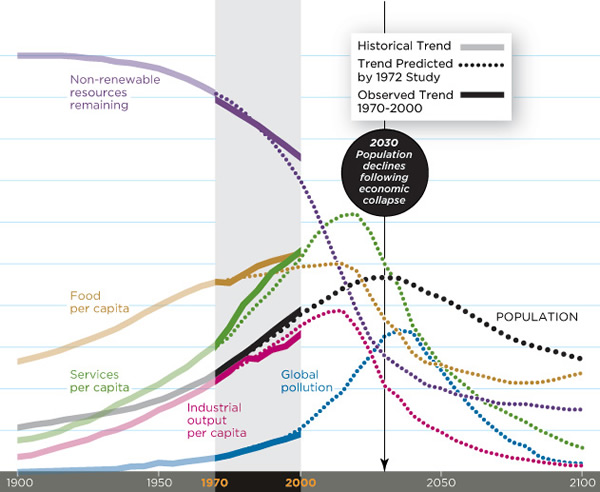
Researchers have regularly revisited the Limits to Growth forecasts in the proceeding decades and the standard model is in line with the real world trends to this current day. You can see the standard model and the 30 year update below. To summarise, a 1972 computer simulation has accurately predicted the major trends of the world economy and biosphere over the last four decades, yet it is hardly known to the general public. The reason why nobody wants to discuss the eerily prophetic Limits to Growth standard model may be in what it forecasts in the future.


futurism-got-corn-graph

  • A catastrophic global collapse in industrial output per capita and food output per capita from around the mid 2010’s onwards.
  • A massive ongoing rise in global pollution which only peaks in mid-century.
  • Services per capita peaks around 2020, after which there is a devastating collapse, with a huge drop within 20 years of the peak.
  • By around 2030 the world economy has started collapsing with ominous implications for the world population which starts to drop from that point onwards.

The only minor consolation is that on a number of the key trends, the real world data is marginally better than the forecasts by the computer simulation, although still in line with the overall model. Some may argue that technology will come to the rescue and save humanity from this bleak dystopian future. Although an energy game-changing discovery like cold fusion could avert our likely future, there is no evidence that such a technological savour is on the horizon. If the world of science is going to rescue us, it should better hurry up, as we are running out of time.

Decades ago, there was still time to ensure sufficient non-renewable resources could be preserved for future generations through a shift away from a free trade oriented world economy dedicated to economic growth. It is probably too late to avoid significant negative repercussions as our fossil fuel supplies become scarcer and ever more expensive to mine. Even the spectre of manmade climate change wreaking havoc hasn’t been a sufficiently strong reason to force world leaders away from the business-as-usual status quo. It is highly unlikely that politics can save the world now.

The trends forecast in the Limits to Growth standard model is the mega-trend driving world economic and political forces. One of the reasons why the Pundocracy increasingly fail to accurately predict major political events (for example the Brexit referendum result) is that they have a total blind spot to the biggest mega-trend impacting on the world. Ordinary voters understand at an instinctive level that the prospects of maintaining a middle class lifestyle are dying. When news viewers see thousands of migrants risking their lives to get into Fortress Europe, they sense, that this is only the beginning of a massive migration wave from a collapsing MENA (Middle East and North Africa) region. And they are right.

Based on the standard model megatrend, as well as other key drivers, here is what I anticipate is likely to happen in the coming decades;

  • The eurozone will collapse around 2020

Historically, European monetary union experiments have lasted on average 20 years and the eurozone is the biggest and most ambitious monetary currency union in European history. It is however in profound trouble with openly anti-Euro parties including the French National Front and the Italian Five Star Movement enjoying a real chance of winning power in elections next year. Should either France or Italy vote to leave the Eurozone, the economic and political implications will be devastating.

The European elite have created a monetary and currency union without a corresponding fiscal, banking or political union. If the eurozone is to survive in the long-run, it needs a functioning supranational federal government which can arrange fiscal transfers from the wealthy northern countries to their poorer Mediterranean neighbours. Public opinion polls show no popular support for such a federalist vision amongst the European public. Even without the Limits to Growth megatrend, it was always unlikely that the eurozone would survive the rising populist backlash by an alienated European electorate. The only question is whether the eurozone experiment, inaugurated in 1999, will collapse in an orderly or disorderly fashion.

  • Nationalistic and populist political forces will continue gaining power

The rise of nationalistic and rightwing populist forces throughout the world is gathering pace. Russian strongman President Putin was one of the first but there are many others in power now, including President Erdogen of Turkey and the authoritarian Chinese President Xi Jinging. One could call it the Putinisation of world politics. These charismatic leaders are popular with the masses and appeal to the nationalistic feelings of their peoples.

The virus of Putinisation is spreading to the Western world. Rightwing populist parties have gained power in Poland and Hungary and only narrowly lost in the Austrian presidential elections recently. The Republican candidate Donald Trump, an admirer of President Putin, is neck to neck in the polls against Hilary Clinton and is likely to win the November general election. The election of Donald Trump as president will be a historically significant event and will signal that the liberal international order has died.

  • The return of the State

As we enter into the long twilight years of shrinking and more expensive non-renewable resources, access to oil, gas, coal and rare metals will become a matter of national security. The state will see a comeback as the market will not be relied upon to ensure sufficient supplies of strategic raw materials critical to a modern industrial society.

The writer John Greer has written about this new era of economic decline and growing world disorder, which he calls Scarcity Industrialism, in a number of articles over the years. As Greer notes, the key feature of this new era will be that “access to fossil fuels and other non-renewable resources will be the key to international power and national survival, but by that very token fossil fuels and other non-renewable resources will continue to slide down the curves of depletion. As resource production in one nation after another drops below levels that will support any kind of industrial system, industrial economies will unravel and give way to other forms of economy.”

States that have strong national security regimes and powerful militaries will be in a strong position to ensure sufficient strategic resources to keep their economies afloat. Power will shift from the finance oligarchs to the generals in the coming decades and a frightened public across the world will demand strong leaders who can preserve their crumbling way of life.

  • The international migration crisis will massively worsen

Experts on the refugee and migration crisis warn that Europe faces the prospect of waves of migration which will dwarf the million and a half that have arrived to date. The German government has been warned that up to 10 million migrants could enter Europe within the next 5 years from a troubled MENA world. As food per capita starts to fall of a cliff in the coming decades, hundreds of millions will be at risk of starvation across the African and Eurasian continents. These people will have nothing to lose by trying to enter a prosperous Europe.

The prospect of tens of millions of predominately Muslim Africans and Arabs trying to enter Europe in the coming decades will accelerate the rise of right wing populist forces to power across Europe. Where there are already significant Muslim populations in western European countries, including France, Sweden, Germany, Belgium and the Netherlands, tensions between the Muslim and non-Muslim populations will continue to worsen.

  • The European Union (EU) will collapse around 2030

The likely collapse of the eurozone around the year 2020 will be a hammer blow to the European Project. It will still be in the interests of the major European powers to keep the union going as economic and geopolitical tensions worsen throughout the world. As the forces outlined in the Limit to Growth megatrend worsen, the ability of an increasingly fragmented and divided EU to survive will diminish, and the EU will eventually disintegrate into nationalistic power blocs.

  • Western Europe is heading towards civil war

The prediction that Western Europe is heading towards civil war may appear absurd but it is a frighteningly real possibility. The Chief of the Swiss Armed Forces, Lieutenant General André Blattmann, has publically warned of the risk of civil war, in December 2015. On 12 July 2016, it was reported that the head of French intelligence Patrick Calwar informed the French parliament that France “is on the brink of civil war” between the ultra-right and the French Muslim community. British Rear Admiral Chris Parry warned in the Sunday Times on 11 June 2006 that western civilisation faced a spectre of a Roman Empire style collapse in the coming decades as mass migration and radical Islam triggers violent unrest. European security and military circles are discussing the risks of civil war in public and almost certainly in private.

If there is widespread and violent unrest from a radicalised young Muslim population, then the cities of France, Belgium, Netherlands, Sweden, Denmark, Italy, Germany, Austria and the United Kingdom will bear the bulk of the fighting. Western European states have cut their military and police budgets since the end of the Cold War and would struggle to put down a violent urban uprising. European governments could have to request American military support but it is not certain that a future US president would send US military forces in a European urban insurgency. Hopefully this grim prospect will never happen and the securocrats are wrong in their fears.

To conclude, we are entering into a twilight era of Scarcity Industrialism where the current financial, economic and geopolitical framework is disintegrating. The Limits to Growth megatrend is driving a collapse of the post-Cold War liberal international order, which will be heralded when Donald Trump is likely inaugurated as America’s next president on 20 January 2017.

Winter is Coming

Et tu, Gove?

The extraordinary political assassination of the front-runner Boris Johnson by his campaign chief Michael Gove, is by any standard, the most stunning political betrayal in modern British history. The Justice Secretary Micheal Gove has spoken over the years that he would never run for the leadership of the Conservative Party. My prediction that Boris Johnson would succeed in defeating Theresa May in the Conservative Party leadership election rested on the assumption that Michael Gove would align himself with the Johnson campaign. 

Now that Michael Gove has unexpectedly become a candidate in his own right, the race for the leadership has been blown open. Boris Johnson’s withdrawal has inevitably made void my prediction of a Johnson victory and is a lesson that there are no certainties in politics. The Home Secretary Theresa May is a formidable and savvy political operator and is in a strong position to win the race. May’s biggest weakness is her timid support for the Remain camp which will do her little favour among the pro-Brexit grassroot activists. 

Michael Gove and the rising star Andrea Leadsom are in a battle for second place in advance of the final vote of the MP’s tomorrow. Whoever succeeds in rallying the pro-Brexit forces to their flag will be in a strong position as the race branches out to the 150,000 strong Tory membership. The only aspect of this race which I will state with any certainty is that Theresa May is not guaranteed to win amongst the membership who overwhelmingly backed the Leave cause. 


Et tu, Gove?

Implications of the Brexit triumph on the US presidential election

The decision by the British people to leave the European Union has stunned the world and has major implications for the US presidential elections, scheduled on 8 November 2016. The media and political elites (the “Pundocracy”) in the United States have dismissed the chances of the presumptive Republican candidate Donald Trump winning the Presidency.

The truth is quite different. Donald Trump, an instinctive politician, sensed the mood of the American electorate which is angry, frustrated and ready for an outsider to smash the failing status quo when he launched his insurgency campaign in June 2015. What the Brexit result signifies is that the working and middle classes are in open revolt and will not be intimidated, bullied and silenced by the political and economic elites on either side of the Atlantic.

Political experts agree that Donald Trump needs to win the Rust Belt states like Pennsylvania, Ohio, Michagan and Wisconsin if he has a realistic chance of defeating Clinton. Reports are indicating that Trump could do very well in these states and Hilary Clinton hasn’t connected with the concerns of blue-collar voters. The Pundocracy are underestimating the anger among the American people and the real levels of support for Trump outside the Beltway. Just as a “shy Brexit” phenomenon contributed to the victory of the Leave campaign, the pollsters haven’t factored into their models the potentially 4% of the electorate who are “shy Trump” voters, who could swing the election.

The firing by the Donald of his top aide Corey Lewandowski on 20 June will be considered by future historians as a key turning point in the Trump campaign. Lewandowski encouraged a “let Trump be Trump” strategy that worked well in the primaries but has backfired with the broader electorate. The experienced and ruthless political operator Paul Manafort is now in charge of the Trump campaign and will direct the pivot towards a more “presidential” Trump.

Donald Trump has seen a sharp drop in the national poll ratings recently with the average poll of polls showing that he is 6% behind to the presumptive Democratic candidate Hilary Clinton. This was triggered by ill judged and inflammatory comments about the Mexican heritage of a judge investigating the Trump University law suit which has amplified wider concerns about whether Trump is fit to be president.

Trump will need to deal with this toxic issue head on if he is to gain traction among minority voters and independent voters. Trump, contrary to what some in the Pundocracy appear to think, is not a stupid man. He is fully aware of the need to adopt a more serious, sober and “presidential” campaign and the firing of his closest aide Corey Lewandowski shows that he now “gets” the importance of the general election pivot I have written of before. The Republican Convention at Cleveland will be a key moment in reshaping perceptions of Trump and challenging the view that he is a racist buffoon.

As long as the Donald stays with the playbook outlined by Paul Manafort and pushes his powerful anti-establishment, inclusive and economically populist agenda with the wider American public, than he will be on course for a historic victory on 8 November 2016.


Implications of the Brexit triumph on the US presidential election