Why the Energy Lockdowns Never Came

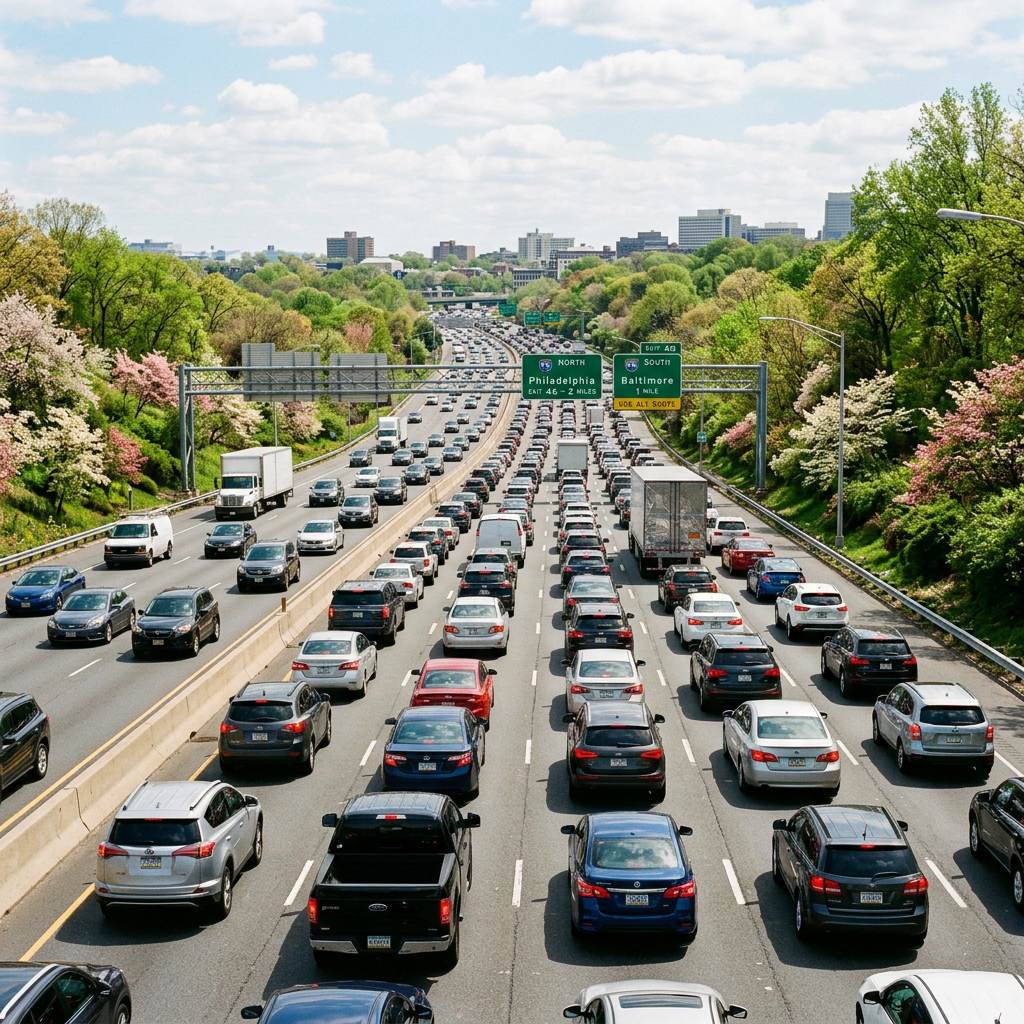
Multiple lanes of heavy traffic on a highway with green and flowering trees on both sides
Dense traffic on a multi-lane highway surrounded by spring foliage

Hi all,

On 1 April, I published an emergency post warning that global energy lockdowns were coming.

My forecast was that the effective closure of the Strait of Hormuz would produce a physical supply shock by around 20 April, followed by petrol and diesel rationing, restrictions on flying, work-from-home guidance and other controls intended to reduce energy consumption.

That forecast was wrong—or, more precisely, it was wrong about how the crisis would be transmitted into the everyday lives of people living in the West.

The underlying supply disruption was every bit as serious as feared. Before the war, nearly 20 million barrels of crude oil and refined products passed through Hormuz every day. By March, export volumes had fallen to less than 10% of their previous level. The International Energy Agency described this as the largest disruption in the history of the global oil market.

Yet the severe physical shortages and energy lockdowns I expected did not arrive across Europe and North America. Oil prices rose sharply, airfares and other energy-intensive costs increased, and poorer import-dependent countries suffered considerably more disruption. But the petrol stations remained open, private motorists continued driving and Western governments avoided imposing meaningful restrictions on public consumption.

Why?

The short answer is that I underestimated three things: the extraordinary capacity of China to alter the global oil balance; the volume of oil already stored around the world; and the political determination of Western governments to preserve normal consumption for as long as possible, even at the expense of depleting strategic reserves.

China: from price taker to price maker

The biggest error in my analysis was China.

For years, China has been viewed primarily as the world’s largest source of additional oil demand. It imported a record 11.55 million barrels per day in 2025, accounting for roughly two-thirds of its consumption and around 16% of global oil demand. On the surface, this appeared to make China exceptionally vulnerable to a closure of Hormuz.

In reality, China entered the crisis far better prepared than almost anybody realised.

As oil prices rose, Beijing dramatically reduced its purchases. Chinese crude imports fell to 7.12 million barrels per day in June, more than 41% below the previous year and their lowest level since 2016. This sudden withdrawal of the world’s largest importer from the market was critical in allowing the rest of the world to absorb the loss of more than 13 million barrels per day of Middle Eastern exports. The scale and speed of this intervention caught many oil traders and analysts by surprise. It certainly caught me by surprise. Reuters has produced an excellent analysis of China’s response here.

China was able to do this because it had spent years constructing what amounts to an oil fortress.

According to the US Energy Information Administration, China accumulated nearly 1.4 billion barrels of strategic and commercially held oil by the end of 2025. It had been adding around 1.1 million barrels per day to these inventories during that year alone. Beijing therefore entered the war with more than 100 days of normal imports already stored.

China also suspended exports of petrol, diesel and jet fuel, redirected supplies towards its domestic economy, reduced refinery activity and drew selectively from its enormous inventories. Refinery throughput in June was approximately 18% lower than a year earlier. Domestic oil production, meanwhile, had reached a record 4.3 million barrels per day, while the rapid expansion of electric vehicles continued to restrain growth in transport-fuel demand.

This did not mean that China painlessly replaced all its missing Gulf oil. Rather, Beijing managed demand within its industrial system instead of allowing Chinese refiners to compete frantically for every available barrel on the international market.

There is an important qualification. China’s suspension of refined-fuel exports made shortages worse in parts of Asia that depend on Chinese petrol, diesel and jet fuel. Beijing protected itself first. Nevertheless, by withdrawing millions of barrels per day of Chinese crude demand from the international market, it created room for Western and other Asian buyers.

China was no longer merely reacting to the oil price. It was helping to determine it.

That is a profound geopolitical development. China has demonstrated that it can increase imports and fill its reserves when oil is cheap, then sharply reduce its participation in the market when prices rise or supply is threatened. Its inventories, domestic production, refinery controls, coal-fired electricity system and growing electric-vehicle fleet now give Beijing the ability to influence global energy markets in a way previously associated primarily with Saudi Arabia, Russia and the United States.

I badly underestimated this Chinese capacity.

The world consumed its insurance policy

The second reason the shock was contained was the sheer quantity of oil released from storage.

On 11 March, the 32 members of the International Energy Agency agreed to release 400 million barrels from their emergency reserves. This was the largest coordinated release in the organisation’s history. The United States contributed approximately 172 million barrels from its Strategic Petroleum Reserve.

Spread over four months, the international release added roughly 2.5 million barrels per day to the market. It did not replace the oil lost through Hormuz, but it narrowed the immediate deficit and reassured traders that governments would not allow physical shortages to develop without intervention.

Other buffers also mattered. The oil market was in a modest surplus before the war. Saudi Arabia and the UAE redirected several million barrels per day through pipelines bypassing Hormuz. Russian and Iranian oil held in floating storage was released after sanctions were temporarily relaxed. Producers in the Americas and elsewhere increased output and exports where they could.

Individually, none of these measures was sufficient. Combined with China’s retreat from the import market, however, they bought the world valuable time.

The result was that the crisis was met through a vast liquidation of inventories rather than an immediate reduction in Western consumption. Reuters calculated that supply disruptions and the policy response removed around 1.5 billion barrels from global inventories during the first half of 2026. By July, US emergency stocks had fallen to their lowest level since 1983.

This is the key point. The missing energy did not magically reappear. Governments temporarily filled the gap by consuming oil that had been produced and stored in previous years.

We avoided an immediate consumption crisis by running down our insurance policy.

The political refusal to ration demand

The third factor was political rather than geological.

Western governments were determined to avoid anything resembling another lockdown. They understood that restrictions on driving, flying or domestic energy consumption would be politically explosive after the pandemic, the inflation shock and years of falling living standards.

The European response was particularly revealing. By late April, European governments had introduced more than 180 measures in response to the crisis, but fewer than ten—mostly voluntary—were intended to reduce consumption. Instead, governments spent billions on fuel-tax reductions, price caps, subsidies and household support.

As Reuters reported at the time, politicians were much more willing to spend money shielding households from higher prices than to tell voters to drive less. Memories of the French Yellow Vest revolt against higher diesel taxes were never far from policymakers’ minds.

The contrast with Asia was striking. A number of Asian governments introduced remote-working requirements, restrictions on driving, reduced air travel, university closures and public energy-saving campaigns. These countries were generally more dependent on Gulf energy and possessed fewer financial and strategic buffers.

Europe and North America instead chose to defend normality.

This was an understandable political choice. Governments exist in the real world, and imposing rationing before actual shortages emerge risks creating panic buying and destroying public confidence. Strategic reserves were created precisely to respond to major supply disruptions.

But emergency reserves are supposed to bridge a temporary interruption. They cannot replace a major producing region indefinitely. Using them to postpone even modest conservation measures transforms a short-term buffer into a potentially dangerous long-term gamble.

Western governments effectively chose the least visible form of rationing. Instead of rationing current consumption, they rationed future security.

The public was allowed to continue driving and flying, while the cost of maintaining that normality was transferred onto government balance sheets, depleted stockpiles and the eventual need to purchase hundreds of millions of replacement barrels. Rebuilding those reserves will itself increase global oil demand and may place a higher floor under prices during 2027 and 2028.

Wrong on timing, but not necessarily on the danger

So, where does this leave my original forecast?

I was wrong to assume that a physical supply disruption would quickly translate into formal Western demand controls. I underestimated the buffers built into the global system and, above all, the ability of China to remove itself from the market at extraordinary speed.

I also underestimated how far Western governments would go to avoid telling their populations to consume less energy. Faced with a choice between unpopular restrictions today and reduced strategic security tomorrow, they overwhelmingly chose the latter.

However, it would be a mistake to conclude that the energy crisis is over or that the closure of Hormuz no longer matters.

The buffers that prevented a severe shock are finite. Strategic reserves have been depleted. Floating storage has been consumed. The easy pipeline diversions have already been made. China can continue drawing from its inventories, but even its oil fortress is not unlimited. At some point, national stockpiles will have to be rebuilt.

At the time of writing, shipping through Hormuz remains a fraction of its pre-war level, while the conflict and attacks on regional energy infrastructure continue. The latest US government forecasts suggest that some Middle Eastern production could remain offline into 2027. The danger has therefore been postponed and redistributed, not abolished.

The crisis has also exposed a significant division in the world. Wealthy Western states purchased political normality with strategic reserves and public money. China protected itself through centralised control of imports, refining and inventories. Poorer and more import-dependent countries absorbed a disproportionate share of the shortages and compulsory demand reduction.

My forecast of immediate Western “energy lockdowns” was therefore wrong. What emerged instead was subtler: the liquidation of accumulated energy reserves to maintain the appearance of business as usual.

That strategy has worked better and for longer than I expected.

The question now is what happens when the reserves have been depleted, the temporary buffers are gone and the public still expects normality to continue.

We may have avoided the first energy shock.

We should not assume that we have abolished the next one.
Why the Energy Lockdowns Never Came

Quick Takes 11

Hi all,

Well, 2026 is proving to be an interesting year! This quick takes will be focused on Iran and wider macro viewpoints.

Who is winning the war?

This is proving to be a very hard subject to answer but I will try. Whilst calling the war is obviously very hard I have been searching for credible observers who I can lean on to give me a clue. The best author to date Stephen Bryen who latest summary of the war can be found here and aligns with my own basecase (so far).

“Overall air defense systems and attacks on Iranian assets are paying off. Systems that are fully integrated are the future of effective air defense systems. Russian, Chinese and Iranian air defenses, on the other hand, mostly did not survive attacks from the US and Israel, apparently using stand off weapons to knock them out. From a broader strategic perspective this indicates that western systems (mainly US and Israel, plus some joint systems like NASAMS) are considerably better than their Russian and Chinese counterparts.

The major US and NATO concern is there are not enough interceptor missiles for a sustained conflict, meaning that (a) production of interceptor missiles must be stepped up and (b) that the best defense is an effective offense, that is, the best solution is to destroy the enemy assets on the ground before they can be used.

One can expect that most of Iran’s missile forces will be effectively neutralized in the next week, opening Iran up to systematic destruction of its military installations and equipment, strategic and tactical communications, and key regime support units (especially IRGC and police units). Iran’s naval assets also are being liquidated and naval bases, including Bandar Abbas and Chahbahar, severely damaged. This means that Iran’s ability to shut down the Straits of Hormuz and Gulf transit of oil is, at best, only a short term threat.”

I recommend you sign up for his free blog.

I also recommend this macro blog post on our wider global crisis, its a really good read. The author rarely posts but it is always fascinating reading. You can read it here.

On that note John Greers latest post is also a cracker about the end of the corporate-bureaucratic age which you can find here.

Quick Takes 11

2025 – a Review

Hi all,

Happy New Year! I hope you all had a good Christmas and New Year break with your loved ones.

Well, in the end, whilst I was a bit cautious in my blogging my gut call that Trump would win the election was proven correct with Trump winning 306 EC votes, something I was privately forecasting to key friends a few weeks before Election Day but didn’t quite have the conviction to forecast on this blog. Lesson learnt is to be a bit more confident in my predictions but the key takeaway is I predicted Trump would likely win and also likely win the popular vote (something very few were predicting prior to the election, including the betting markets).

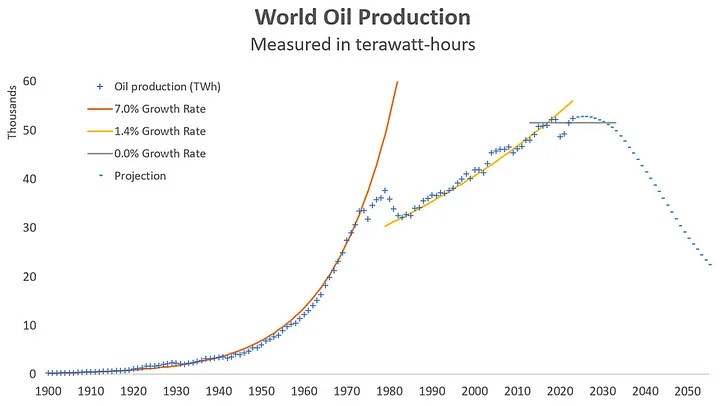
From a macro perspective, I don’t see 2025 to be that different from previous years. We are on a bumpy plateau of energy production globally with things bumping along until the end of the decade, even though the energy required to generate the newer energies continues to rise.

Honest Sorcerer

“BeardTree, granted. The question is purely how long they can keep going before hard physical limits come into play. What’s happened so far is that increasingly energy-poor grades of liquid fuels have been brought into the mix, so that notional production stays high but the net energy (energy yield minus energy cost of production) drops steadily. As long as they can keep playing that game, we can expect slow erosion of lifestyles rather than sudden discontinuities (from that cause, at least).”

As John Greer notes above in his recent blog Q & A we don’t know long they can carry on this playing this game. Probably for a few years to come. One of the biggest sources of energy, US shale has probably peaked and is on its own plateau for the next few years before it starts to fall around 2028/2029. So, my best guess, is 2030 or around that year, when that game comes to an end and we get the “sudden discontinuities”.

honest sorcerer

Those are likely to include serious economic and political crises, including market crashes and a globalised banking crisis for the history books. If major economies have tipped or are tipping into economic contraction markets will at some stage price that into bond, equity and other asset markets. That will cause havoc for banks that lend credit and hold government and corporate bonds on their books (among many other assets).

My base case remains that this crisis will hit, certainly the United States, around 2029 but its possible it starts to impact other countries (hint, Germany and other stagnating European countries) earlier in the decade.

Either way, my personal message remains the same, Get out of debt, be sensible in spending, develop skills and alternative income streams, enjoy life and the opportunities that currently exist in our industrialised civilisation (like internet shopping, relatively cheap global travel etc).

From a geopolitical perspective, I expect at some point in 2025 some kind of deal between Ukraine, Russia and the West that ends the war. I’m sure both sides will declare victory but if the Russians carry on their military progress it will be a de facto win for the Russians.

Syria, despite the best hopes of some in the West, is likely to descend into anarchy and sectarian war as the new Islamist government shows its true colours.

Iran, having lost its external empire of proxies and terrorists in 2024, looks very vulnerable to an internal revolution. I don’t know if it will but I wouldn’t be shocked if some kind of crisis – maybe severe water shortages or the grid going down – triggers protests that lead to the overthrow of the Mullahs.

I don’t think we will see any clash in East Asia – at least in 2025 – over Taiwan. The election of President Trump provides the opportunity for a Grand Bargain between the United States and China. Whether a war or near-war happens later on this decade remains to be seen but Trump is less likely to trigger a war over Taiwan than any other US political leader.

Europe will continue to economically stagnate, hobbled by expensive energy, unsustainable welfare systems and a political-regulatory system that crushes the private sector. I don’t see any elections within Europe that really changes that dynamic for the foreseeable future. My sense is 2029/2030 is when the revolutionary tides comes for the failing European political class and we see populist and insurgents come to power in western Europe. A good case on why Europe will fall is made by this author here.

What happens in America, specifically whether Musk and his allies can really transform the US federal government into a leaner and more productive apparatus will be fascinating to watch. DOGE has the potential to transform the West’s politics and is already exerting pressure on a failing Europe to start de-regulating. It won’t happen of course, at least for a few years, but one can see the winds of change howling across the Atlantic.

Woke politics has peaked and is now on the decline. Once the higher education system – which is slowly going bankrupt anyway – starts to crumble the ideological centre of wokeness will go with it. That’s a good thing and will restore sanity to our politics.

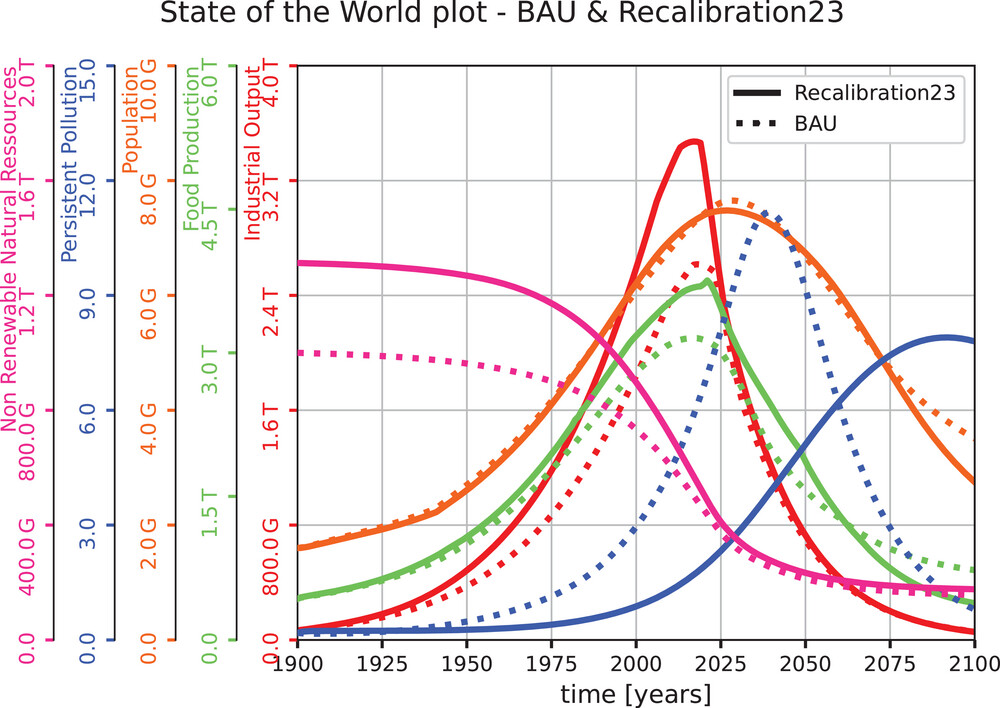
A few analysts I follow are predicting that Artificial Intelligence (AI) will save us in the 2030s and beyond. Supposedly AI will help unleash a new era of cheap energy powered by fusion and SMR’s (small modular reactors), our economies will become vastly more productive and so on. I’m not saying that AI doesn’t have potential and won’t make major advances in certain areas (like biotech, financial services and defence) but I can’t help but feel sceptical on a number of grounds – the energy cost of the data centres – the issues around hallucinations and the usual hype cycle we see in AI going back to the 20th century. So for me, whilst the jury is out, I’m on the sceptical side that AI will, at best give us a few more years, maybe, but it doesn’t fundamentally change the LTG BAU model I’ve been tracking since the early 2000s.

So, on that cheerful note, have a good year!

2025 – a Review

US Presidential elections – update and forecast

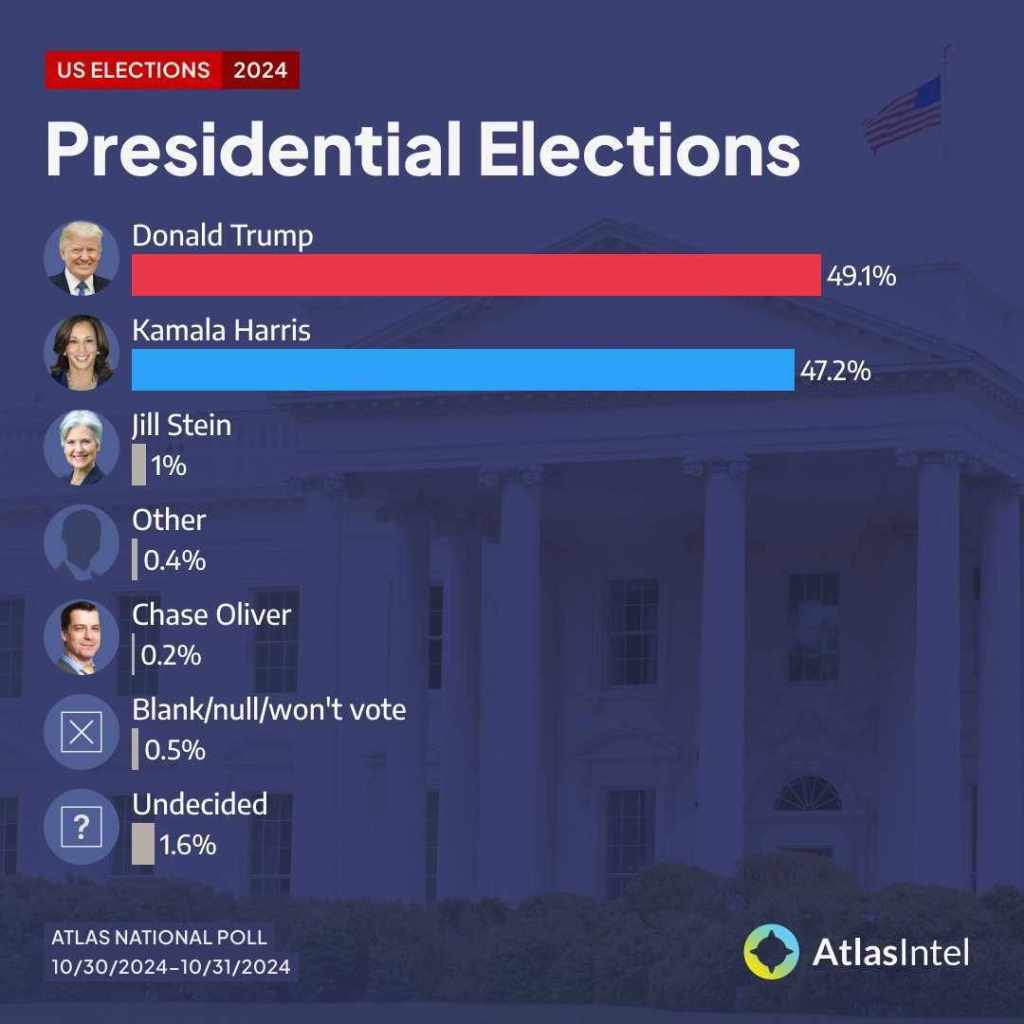
Its nearly that time of the four year presidential cycle again! The polls are close, very close in some of the swing states and tensions are high as America gears up to choose their next president next week.

So where are we on the state of play? Early voting has overall been positive for Republicans, and in particular in Nevada where its looking increasingly likely that Trump will win that state. The so-called Sunbelt states in general are looking promising for the Republicans, including Arizona, Georgia and North Carolina.

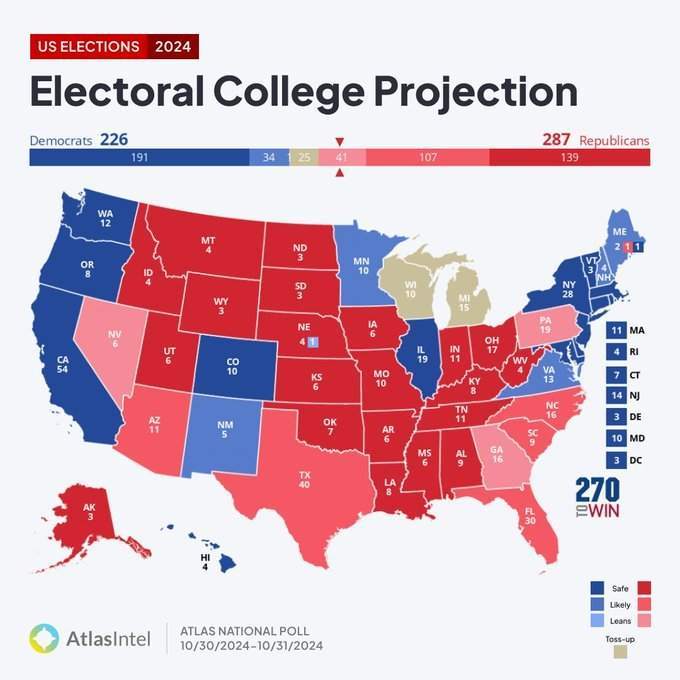
Where things are looking far more difficult to predict is the so-called Rust Belt states; Wisconsin (WI), Michigan (MI) and Pennsylvania (PA). In the public polls, Trump has a narrow lead in PA but its effectively a tie in the other two states. I screen my polling to those pollsters who had the best success in 2020 and the overall map they are showing is the following:

As you can see, the overall picture seems to be a likely Trump win but PA is the key state. There are tentative signs that after sliding slowly over the last week or so, the Harris campaign has stabilised and could prevail in at least WI and MI.

One thing is for certain, WI and MI will be extremely close, with PA only a bit closer to the Trump side of things.

My own view is that either side can win this election but I would be surprised but not shocked if Harris pulls of a victory. However, my base case – with around 60% confidence – is Trump will win with 287 plus EC votes and quite possibly a win in the popular vote.

Historically the Rust Belt states vote together so history would suggest Trump should win all three states taking his EC lead to 312. It is simply too hard to say whether this happens this time or not though.

There is also the risk, certainly backed by the recent polling in places like New Hampshire or Virginia, that the Republicans might be able to flip one or more states, on a particularly good night, on top of the Rust Belt. We simply don’t know.

And on that note, enjoy election night!

US Presidential elections – update and forecast

Quick Takes 5

The global macro landscape continues to evolve in fascinating ways. Here are the best links I came across recently that you might find interesting:

2024 – A perfect global storm

With the crisis in the South China Sea now more or less permanent, the lack of mission-capable ships is the main reason why last December the Navy dedicated a remarkably small strike group to Operation Prosperity Guardian in the Red Sea, consisting of one aircraft carrier and three escorting destroyers. The British provided one destroyer, while Denmark and Greece promised a frigate each. The Netherlands, Norway, and Australia are together sending two-dozen military personnel in all, but no vessels. Singapore’s navy is providing a center “to support information sharing and engagement outreach to the commercial shipping community.”

This amounts to an utter debacle, effectively the U.S. has zero contribution from all but Britain. Australia’s refusal to send ships is a particularly unpleasant shock to the administration. Some nominal members of the operation have even refused to announce their participation in public for fear of being linked to Israel and suffering military or terrorist reprisals.

U.S. military bases in the region—notably in Bahrain, right across the Gulf from Iran—appear potentially more vulnerable than ever before.

Coupled with the looming defeat of the Armed Forces of Ukraine, likely followed by a major Russian offensive come summer, the global mix is becoming volatile in the extreme.”

The Sun Sets Slowly – then quickly

“America is a naval empire. It, like the old British empire, rests on being able to keep the shipping lines open and on using naval power (and air power) to hurt nations while those nations can’t fight back. In the 19th century the Brits would park ironclads off the coast and just pound cities, and there was nothing those cities could do in return.

This is, then, one of the key moments in the end of Western hegemony. The point at which we no longer have deterrence; at which we can no longer “big foot” other nations.

The end of Western dominance is close, very close. I can taste it, like a hint of salt on a sea breeze. The Chinese are only behind in a few technological areas. Once other nations can get everything they need from China/Russia and other lesser nations they will be free to throw off the Western order, because the new and improved missiles make “stand off and bomb” far less effective than it used to be.”

NATO warns of all-out war with Russia within 20 years

“Civilians must prepare for all-out war with Russia in the next 20 years, a top Nato military official has warned.

While armed forces are primed for the outbreak of war, private citizens need to be ready for a conflict that would require wholesale change in their lives, Adml Rob Bauer said on Thursday.”

Growing talk about bringing back national service and a return to a war economy across Europe now. The war drums are starting to beat louder and louder.

UK defence minister warns of regional wars in 5 years

UK minister warns the world is in a pre-war era and should prepare for wars against Iran, Russia and China in 5 years (e.g. 2029).

Obviously, the risks of regional wars across the world will shatter the global economy and the globalised supply chains.

All this seems painfully like the updated LTG BAU model doesn’t it? And note it all unravels from the mid-2020s onwards, around the time US shale is supposed to peak and rollover…

Quick Takes 5