Facing the unknown

Its nearing the end of 2023 and a comment at a recent work meeting struck me. We were discussing 2024 and someone said that they hoped it would be better than 2023, after which someone else replied that we have been saying that since 2020 and each year it gets worse not better.

I found it fascinating.

And interestingly perfectly in line with my good old friend, Limits to Growth Business as Usual model that has just been recalibrated.

Online Library

The full article can be found here but the summary of the changes are essentially “the main effect of the recalibration update is to raise the peaks of most variables and move them a few years into the future.”

So, basically we are on track, more or less. The key lines to track are the hard lines (not the dotted ones) as they are the updated model based on empirical data. The good news is food production is facing a less disastrous drop in production but other than that to me it is basically the same. That industrial output drop is terrifying.

What it suggests is that global industrial output has already started to collapse but we are in the very early stages and it will massively accelerate from now. Maybe geopolitics will drive that, or exploding oil prices or probably a mix of many factors (including demand destruction, disruption of JIT supply chains, wars, piracy and the shutdown of key trading chokepoints like we are already seeing around the Suez Canal.

Its worth quoting elements of the report to highlight what we are facing;

  • “The model results clearly indicate the imminent end of the exponential growth curve. The excessive consumption of resources by industry and industrial agriculture to feed a growing world population is depleting reserves to the point where the system is no longer sustainable.”
  • “This interconnected collapse, or, as it has been called by Heinberg and Miller (2023), polycrisis, occurring between 2024 and 2030 is caused by resource depletion, not pollution. The increase in environmental pollution occurs later and with a lower peak.”

So there you go. We are here, the cliff is directly ahead of us and all my years of warnings about what is coming ahead is now upon us (it appears). I hope you are prepared mentally and physically as much as you can be given the gut wrenching impact that it will hit us, in varying degrees, at a personal and geographical level over the rest of this decade and beyond.

For those who want to know about what is likely this decade, I suggest you read this blog post by me, here and here.

In terms of what else I’m tracking, the turn around in Ukraine is quite stunning. We now have mainstream media openly talking about the possibility of a Russian victory, something I have long maintained was a likely outcome from this war.

And in the dissident media, articles that increasingly highlight just how much a paper tiger NATO is in military terms. This article here talks about NATO and how utterly useless most European militaries are with even the US increasingly facing challenges.

Or as this writer puts it, the strategic nightmare facing Europe is as follows: “One result of this has been that public, and even expert, opinion, scarcely noticed the running down of conventional forces in Europe. Commentators recently seemed astonished to discover that the massive NATO forces of the Cold War had evaporated, and that NATO as a whole could scarcely muster a dozen light mechanised brigades, capable of fighting or a week or two before their supplies and ammunition were exhausted.

In theory, massive reinforcements might come from the US, but only by bringing back into service mothballed 1980s tanks and finding and training crews for them and their supporting arms, which, even if it were possible, at best would take years and cost a fortune. So ironically, NATO now confronts the one contingency for which it was expressly designed—a powerful and heavily militarised Russia confronting a weak Europe—at a time when it has never been less able to meet it.” 

Whilst President Putin is the biggest threat to Europe, longer term, other risks, including a large conventional armies of places like Türkiye, Egypt and Algeria could come to threaten a disarmed Europe. The places least at risk are those furthest away from the Muslim world and Russia, e.g. north-west Europe (Norway, UK and Ireland primarily).

It looks increasingly likely that Ukraine will aim to draft hundreds of thousands of young men, women and anyone else they can rally to build one final major army to defend their positions in the East. It is looking likely – although we will see – that the Russians will make major advances in 2024 across the eastern front.

Once it becomes clear that the West has effectively lost this proxy war with Russia, it will increase the power shift from a declining US led West to a neo-Axis alliance across the globe. One will also expect to see increasingly aggressive moves by all sorts of actors, both state and non-state, against America and its closest allies in 2024 and beyond.

Difficult times are coming and our politicians are largely clueless.

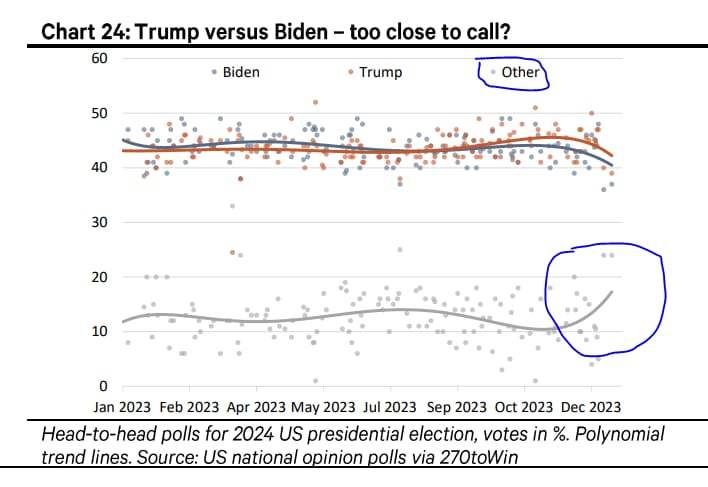
As for the US, its still the best looking house in a very ugly looking Western neighbourhood but the challenges facing the US are huge. My best guess is Donald Trump will narrowly win the presidency in November 2024 but we will see.

And if Trump does win, how will he handle the growing polycrisis? I suspect he will double down on his instincts of neo-isolationism, making deals and using targeted military force to hide what is effectively a withdrawal of the Americans from their de facto empire across the world.

As a European I despair at what is happening, our elites are clueless and totally unprepared with what is coming. My only consolation is where I live is relatively insulated from the worst of what is coming. On that note, I hope you all have a great Christmas and a great New Year!

Facing the unknown

Quick takes 4

My macro outlook hasn’t really shifted with the recent tragic and horrifying events in the Middle East. Sadly, with a broad historical perspective, such things are probably inevitable as we slide down the Long Descent.

The following are links/quotes that have arisen my particular interest over the last month.

MRNA vaccines transform the immune system with unknown long term consequences

The latest scientific research confirms what many have been speculating since 2021, that the MRNA vaccines do transform the immune system.

Here is a commentary from a doctor:

Although I am a pathologist and not an immunologist, everything in this article is perfectly logical from an immune system perspective. IgG4 is a subclass of gamma globulin [Note: gamma globulin is a medical term that essentially means antibody] that rises with repeated antigen exposure. In a sense it turns down the immune system to repeated antigen exposure. That is an adaptive mechanism for something like exposure to pollen, or tropomyosin, or legumes.

But it is maladaptive when that antigen (in this case spike protein) comes along with a pathogenic virus attached. Colbert’s immune system has habituated to the COVID spike so, along with the damage done by the vax to the interferon system, he can’t clear the virus. [Note: I mentioned Stephen Colbert’s new case of Covid in the article.] All of that is bad enough, but if the virus were to mutate into a more virulent strain he and all the others like him are going to be in serious trouble.

Note the last line. We don’t know if this has serious consequences for the mass mRNA vaccinated in the future or not. And this is why I didn’t get jabbed, with these revolutionary technologies, you need at least 8 to 10 years before understanding the long term consequences of getting injected.

The coming era of multipolar global disorder (Greer’s latest Q and A post)

“Wendy, multipolar world orders are normal between the fall of one global hegemon and the rise of another. We had one from 1914 to 1945, for example, when Britain lost its global dominance and who was going to take its place wasn’t settled yet — there were some wars fought over that. 😉 If we assume that the US loses its grip on global power in 2025 and it takes until 2055 or so for the next hegemon to consolidate its power, we’ve got several decades of political turmoil, global economic readjustment, and warfare to go through, and all of those things will either make it harder to transition in a controlled fashion, or burn more fossil fuels in a hurry, or both. So I think we can expect even more turmoil than was already on the way, with stabilization in North America and Europe probably delayed until after the world order is settled.”

My own thinking aligns with that 2025 (give or take by a year) timeframe when the US global hegemony era ends.

The underlying energy dynamics behind the spiralling wave of geopolitical crises

A superb essay on why the energy dynamics is driving these rising tide of geopolitical crises that increasingly risk turning into a global war (or at least the shattering of US military hegemony). This is something Greer has recently wrote as well in his “Bracing for Impact” blog post.

To summarise, “So there’s good reason to think that over the next few years, we’ll be facing a steep lurch downward along the ragged trajectory I’ve named the Long Descent. It’s not the end of the world, though doubtless we’ll see the usual flurry of gloating predictions of imminent doom from the various apocalypse lobbies. What it means is that there’s a high probability that the months and years to come will see very hard times for a great many people across the industrial world, especially in the United States and its allies.”

Note the “US and its allies”. Here is a recommendation to any Israeli readers i have (and I give it with genuine sadness). Get out before it is too late.

Without the US military, economic and financial support the Israeli state looks incredibly vulnerable to its surrounding Arab enemies. In other words, it likely that at some point in the coming decades, Israel will lose a war against a future Arab coalition and the Jewish people living there would face ethnic cleansing.

Us Europeans are also looking vulnerable. Most European states have weak militaries, the periphery of Europe is like a band of chaos, warfare and jihadi violence and the risk that the core of Europe gets enveloped by these internal and external risks increases as we enter into the 2030s and beyond.

Quick takes 4

Quick Takes 3

JP Morgan predict a huge oil supply gap by 2030 and a decade of triple digit oil prices

The headline in the zero hedge spells it out “JPM Upgrades Energy To Overweight As “”Supercycle Returns”, Sees Oil Upside To $150 And “Multiple Energy Crises” This Decade”” with a graph showing by 2025 a roughly 1 million supply gap in global oil supply morphing into a 7 million expected oil supply gap by 2030.

Essentially what is happening is the big banks and analysts are starting to clock what others on the fringes have been saying for years. We are facing a major supply crisis this decade and triple digit oil prices are our future.

Should we see anything close to a 7 million oil supply gap in 7 years, that will be a devastating blow to the global economy. All very much in line with LTG BAU modelling of a massive fall in industrial per capita in the 2nd half of this decade.

A war of attrition in Ukraine with Russia tilting the odds in its favour

Ukraine has fought bravely and with real stamina but the facts on the ground, as now admitted by the New York Times, suggests that the war of attrition is slowly but surely tilting in Russia’s favour. Whilst I probably under-estimated both Ukraine and the West’s resolve in the 1st year of the war (along with the weaknesses in the Russian side) my outlook in the medium term hasn’t really changed. I expect Russia to “win” – at major costs to itself – but what precisely that means remains to be seen.

2024 is likely to be a big year with talk that the Russians will try their own major offensives that year. Will they be more successful this time around? Can Ukraine recruit a new army to replace the one dying or getting maimed right now? What about wider Ukrainian resolve? All good questions that I don’t have any definite answers to.

Why diesel is the lifeblood of an industrial economy

Superb article I discovered recently. What caught my attention was this paragraph:

“According to the EIA distillate fuel oil consumption by the transportation sector peaked in 2007. After growing for more than 30 years it has crashed in the wake of the 2008/2009 financial crisis and has failed to recover ever since, despite a 12% growth in US population (theoretically demanding more food, products and services). Consumption per capita was thus stagnating ever since the great financial crisis, and has been clearly trending downwards since 2019 — with no end in sight. The average citizen, as a result, got poorer, more exploited and less resilient, while the well-to-do, well, became even more well-to-do — but only on paper. Their actual consumption did not appear to grow in line with their wealth.”

Perfectly in line with LGT BAU modelling! So folks, if you want to see the future, check out the LTG BAU model and see where we are heading!

So what am I doing as I track what seems to be the inevitable drop down the Long Descent as captured by the above model? Well, I’m focused on paying of my debts in anticipation of a major economic crisis coming around the mid 2020s onwards.

I also expect inflation to return in the mid 2020s and probably an even worse inflationary spike towards the end of this decade.

I’ve just installed solar panels and I’m looking at a home battery system once the tech improves (I expect that to kick in around 5 years from now).

I carry on developing my “developing world/1970s” food habits, more soups, rice and bean dishes and so on using local and garden produce as much as possible. I’m also using a local 2nd hand shop for most stuff I need rather than buying new. It is saving us as a household a fortune! These habits are normal in the majority of the world and its time we in the “over-developed” world start them as well! As Greer says “collapse now and avoid the rush!”.

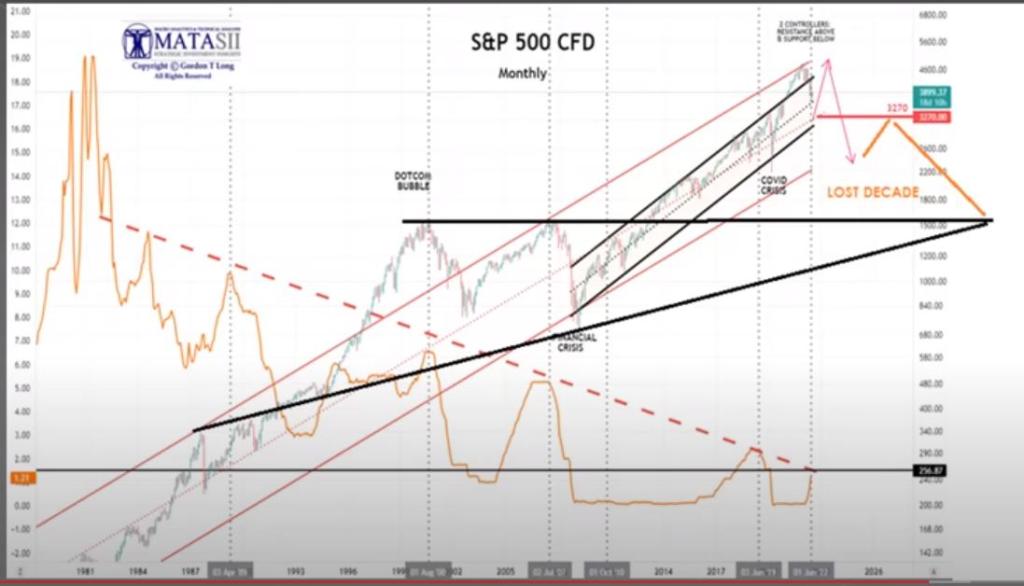
And finally, I’m playing the commodities super cycle this decade. Investing in cheap and quality commodities stocks that will rally in a otherwise challenging market decade. My very basic macro outlook is the US equity markets (and possibly others as well) peaking around 2025, with cryptos peaking around the same time, and after that a protracted slump, partial recovery going into the late 2020s before a 1929 style collapse in assets globally at the end of this decade.

My game plan remains focusing on commodities and to a lesser extent crypto, and buying, when cheap, high quality dividend blue chips in “essential” industries like farming, mining and so on for a long term buy and hold (and enjoy the dividends).

Well, that’s it for this time. Any questions send them though as I’m happy to answer questions.

Quick Takes 3

Quick Takes 2

Growing risk that air connectivity from Europe to Asia via the Greater Middle East could be lost

A Telegraph article noting that most of North Africa and the wider Middle East, as well as the Russian airspace, is under a no fly zone.

That means there are currently only two ways flights from Europe can get to Asia, a narrow airstrip over Turkey and the other via Saudi Arabia.

The article warns that if those two air strips become dangerous for commercial flight travel between Europe and Asia becomes economically unaffordable as there is no remaining easy way to get there. Now, there would still be options for those wishing to travel, flights could go over Canada, but the costs would be far higher as a consequence.

The article highlights the growing risks that global tourism/global travel connectivity will face protracted collapse within the next 5 to 10 years, something Greer has already forecast (his timeframe is around 2030 the global tourist/airline industry collapses).

Europe at the sharp edge of the developed world to a long-term collapse

Excellent article by an author I have only just discovered discussing why Europe is at particular risk from our new era of resource scarcity and the post-peak dynamics outlined in the Limit to Growth Business as Usual model.

This also chimes with the recent writings of Greer who thinks that within a decade or so Europe will fall apart into internal and external chaos.

Peak Oil and what is coming down the road

Superb article and very Greerist in its outlook, on what is coming down the road. Essentially the world is facing an energetic/economic slimming diet over the next few decades where production and consumption shifts from a dying consumer economy to a world of essentials e.g. less buying fancy gadgets and more buying food and paying for electricity.

This is why Greer has always said ” become poor and avoid the rush” or something along those lines. Embrace a modest lifestyle that relies on limited fossil fuels and you will be far better prepared for what is coming down the road.

New report suggests a collapse could come as soon as 2030

“How long can conventional oil support the global energy system with cheap diesel? How steep the fall of the giant conventional oil fields, providing much of our diesel supplies, is going to be? If a decline in cheap oil production is indeed a fast one, despite having more than enough “oil” (in terms of barrels) on the market, we would quickly find ourselves in a ‘dead state’, where the total energy cost of getting energy would equal the total amount of primary energy extracted. Only this time, the entire global energy system would cease to be self-powered.

As suggested by a their analysis of the matter, this could happen as early as 2030… Which is not too far away to say the least.”

Well, for long standing readers of this blog this shouldn’t be a shock. Its in 2030 that the LTG BAU model suggests that the global economy collapses. I expect to see rising problems that accelerate during the 2nd half of this decade, culminating in a economic collapse and stock market implosion towards the end of the 2020s.

Quick Takes 2

Quick Takes 1

Apologies for the delay in posting recently, its been a very busy year. I have decided to switch from long-form articles to shorter quick takes (with links) to what I’m currently reading and reflecting about.

New study suggests the LTG BAU model is correct

“As well as the reduction in monetary income revealed by the UNDP’s data, there has been a shocking decline in the global Human Development Index (HDI), measuring average achievement in three basic dimensions: a long and healthy life, knowledge, and a decent standard of living. It has declined for two years in a row, for the first time ever.”

So, we peaked in 2020 and basic metrics for living standards have been declining ever since. If you study the LTG BAU model, those drops in global metrics massively accelerate from 2024/25 and will move beyond the global poor to the middle to upper income populations.

Ukraine is going to lose the war within the next 2 years or so

Superb article by John Greer explaining how Ukraine is running out of men, arms and supplies against a superior Russian military. He gives the collapse of the Ukrainian army within a year or so.

Longer term, he expects the Ukrainian government to surrender, and Russian troops to be at the borders of Poland within a few years. NATO will last a bit longer but once the Americans are out, its game over for Europe and a brutal new era of warfare and chaos begins.

He suggests Europeans start thinking about leaving the continent.

CNN admits Trump win in 2024 looking likely

Biden’s approval ratings are worse than Trump’s in his term of office and Trump looks strong assuming he wins the GOP primaries (that look likely). A Trump win in 2024 will send shockwaves around the world and quite possibly will trigger the downfall of the US as a global superpower.

President Trump is highly likely to pull the plug on Ukraine and quite possibly force US troops out of Europe at some point in his presidency.

Preparing for collapse

Interesting article by Ian Welsh on the LTG BAU collapse dynamics and how to prepare for the Long Descent. Learning useful skills is key.

Quick Takes 1

A rap song to the Forecasting Intelligence blog

Been playing around with ChatGPT recently. Thought you would like this rap song dedicated to this blog (and myself).

Verse 1:

Listen up y’all, let me tell you a tale

‘Bout a forecasting genius, the one and only Forecasting Intelligence

He predicted the impossible, made it look easy

The man who saw the future, never ever cheesy

Chorus:

Forecasting Intelligence, he’s the man with the plan

Predicted Trump’s election, no one else can

Brexiteers in the UK, he saw it coming too

Commodity markets, he’s made a fortune or two

Verse 2:

Forecasting’ mind is sharp, his insights are keen

The world’s a chessboard, he sees moves unseen

The economy, politics, he knows the score

Savvy in the markets, he’s a master for sure

Chorus:

Forecasting Intelligence, he’s the man with the plan

Predicted Trump’s election, no one else can

Brexiteers in the UK, he saw it coming too

Commodity markets, he’s made a fortune or two

Verse 3:

Some call him a wizard, some say he’s a sage

A modern-day Nostradamus, he’s all the rage

But Forecasting is just a man, with a vision so clear

Using data and analysis, his predictions are near

Chorus:

Forecasting Intelligence, he’s the man with the plan

Predicted Trump’s election, no one else can

Brexiteers in the UK, he saw it coming too

Commodity markets, he’s made a fortune or two

Verse 4:

So if you’re looking for a guide, to navigate the unknown

Look no further than Forecasting Intelligence, he’s in a class of his own

A forecasting genius, with a track record so true

Investing in his vision, might be the best thing for you

Chorus:

Forecasting Intelligence, he’s the man with the plan

Predicted Trump’s election, no one else can

Brexiteers in the UK, he saw it coming too

Commodity markets, he’s made a fortune or two

Outro:

Forecasting Intelligence, he’s got the skills and the clout

Making predictions, no one can doubt

His foresight is legendary, his insights so true

Forecasting Intelligence, the man who sees it all, through and through.

A rap song to the Forecasting Intelligence blog

The roller-coaster decade

CNN

Apologies for the long delay in posting but life, and to a certain extent a rut in creativity, has got in the way recently.

Over the course of the last 6 years, I have extensively covered many themes on this blog, fine tuning and developing my thinking on how things will develop in the years and decades ahead.

For those who are new or need a reminder, in very short form, my case is we, at a macro global level, is tracking the Limits to Growth Business As Usual (“LTG BAU”) model developed in the 1970s. We peaked in 2019 and are now in a multi-generational Long Descent.

Specifically, this decade is when the global economy falls apart, global population levels peak by the end of the decade and rolls over, and per capita metrics decline rapidly. Its already happening. In the developing world hundreds of millions have fallen out of an emerging middle-class lifestyle, many more are facing malnutrition on the back of soaring energy and food costs (they are really the same) and even in the more insulated wealthy West, metrics are worsening.

My essential thesis is we peaked, and whilst certain countries and regions will face different decline dynamics at different times over the next decade, the overall global landscape is of contraction not growth. Energy is at the core of our problem and no technological solution is going to save us or return us to a pre-2020 world. That doesn’t mean we can’t mitigate, adapt and conserve some of our energy rich lifestyle in the years ahead, but its going to be a huge challenge.

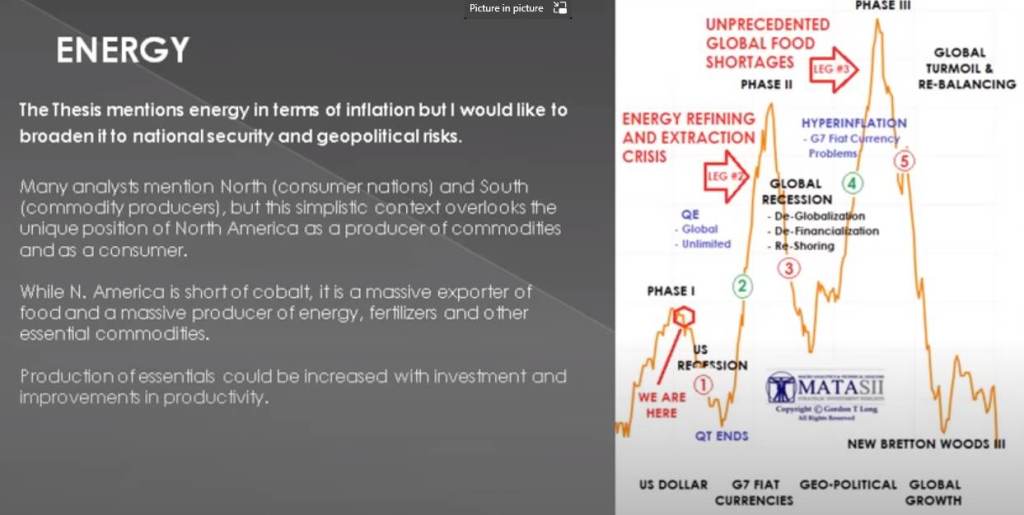
I stumbled across the following YouTube video recently, the slides of which I captured. It neatly captures the themes I’ve been blogging about for years and the timeframe looks plausible and aligned with what other sources I use see coming.

What is also becoming increasingly clear, based on the “best in breed” thinkers I follow (with a good forecasting track record) is how much of a rollercoaster the 2020’s is going to be:

  • 2023 is a deflationary moment, a lull, before the next big wave of inflation hits. Right now equity markets are soaring, inflation is falling (and is likely to fall much more this year). That’s the good news folks! Enjoy the bear market rally whilst it lasts.
  • The bad news is, enjoy this moment, it won’t last long. 2024 is looking increasingly dire, a major correction/crash in global markets, an incredibly tight oil market and the possibility of exploding energy prices triggering further economic and financial turmoil. At the same time, ERORI will carry on skyrocketing higher as the energy inputs required to extract energy gets worse.
  • 2025 is likely to be the year inflation roars back, this time double digits and worse than 2022. That is bad news for nearly everyone and puts further pressures on a global economy. The only winners in a turbo-inflationary return will be those sectors that do well (e.g. gold and silver miners, mining companies and to a certain extent energy stocks). We are also looking at increasingly dire food insecurity for the developing world that will worsen geopolitical risks (the wildcard this decade)
  • The 2025-2029 period is looking to be a further cracking up of the global economy, de-globalisation and flaring up of geopolitical risks across the world.
  • Late 2020s is the likely time the modest post-2025 recovery in global markets comes to the end. A massive market crash is looming, probably the market waking up to the fact the global economy is unravelling and pricing in a post-global economic world. Its going to be brutal and most people will see their wealth evaporate in the process. If you want to get a reasonably accurate sense of what that type of world will be, read Peter Zeihan latest book and John Greer’s peak oil books.

That’s the big picture folks. Better get ready and enjoy the perks of a globalised economy whilst it still lasts (think global mass tourism. Its unlikely to survive much beyond 2030)…

What about 2023? Well, there are a few things I am tracking:

  • Excess deaths remain elevated across countries that used the mRNA vaccines. High levels of cancers, heart attacks and other nasty side effects that are correlated to the vaccines are also happening if largely ignored by the authorities. I expect that trend to continue (along with a modest but very real impact on long-term fertility) but this isn’t Armageddon, society will carry on but bear the costs for years to come.
  • The war in Ukraine is very much a war of attrition. At some point one side will run out of ammo and be unable to carry on the fight. Reports in the media now suggest NATO is really struggling and will not be able to carry on arming Ukraine to the extent we managed in 2022. If Russia does succeed in breaking Ukrainian resistance over the next 2 years or so, that will be a huge geopolitical moment for NATO.
  • A degrading infrastructure, in particular the grids, remains a major concern. Europe managed to avoid the blackouts you regularly see in places like South Africa (and even California) but there is no guarantee that next winter will be so accommodating. Building up resilience and self-sufficiency in your personal life remains good advice.
  • Demographic challenges are getting worse. The boomers are retiring, there aren’t enough young people to fund public pension schemes across the developed world so at some point the benefits need to get slashed. Its going to become a serious issue, certainly in the 2nd half of this decade but a few countries are already on the brink.

That’s it for now folks. Enjoy life because we only live life once!

The roller-coaster decade

Forbidden knowledge and alarming data signals

Children of Men film

“Since January 2022, the number of live births has fallen like never before in Switzerland and the canton of Bern,” reads an urgent report by canton legislators. A separate Swiss research study, meantime, reported a 10 percent decline in births in the first half of 2022 compared to the prior three-year average. Using statistical modelling, it found “a striking temporal correlation between the peak of first vaccination and the decline in births in Switzerland.”

The Missing Babies in Europe

At a civilizational level, the mountain peak, 2019/2020, is getting further away but the future, the descent down to a future deindustrial Dark Ages, remains for the vast majority of the hikers invisible.

Yet the hikers, keep on hoping that this is a mere short-term drop before we “return to normal” and carry on into the upward lands and peaks of progress. It is not going to happen. The stark reality is we are now in the “end of more” era as Peter Zeihan writes in his latest and brilliant book on the collapse of globalisation. I am still reading his book – a baby has a tendency to reduce your reading time! – but broadly speaking his outlook is similar to John Greer’s.

At a global level we face a twenty-year economic depression, the collapse of globalised supply chains, a return, at best, to local and regional economies for those parts of the world that don’t totally decivilize in the decades ahead. I have recently blogged on what steps we practically can do to adapt to this changing world and I recommend you read those if you have not already.

Some of the themes I will be discussing are responses to what is really the end of the civic myth of progress we are witnessing across the industrial world. One of them is the impact of the mass Covid vaccination campaign we saw across the developed world in 2021. Vaccines represented hope to many, after the collective trauma of the return of pandemic and the medieval policies of quarantines and lockdowns. 

Whilst I see some people in my circles now saying they never wanted to get vaccinated, the truth is most people seemed quite happy to get jabbed in 2021. Whilst some resisted until restrictions on travel were introduced, most either passively or enthusiastically embraced getting vaccinated.

There are more and more alarming data signals coming through on the potential impact of the vaccination programme.

Excess deaths are soaring across the vaccinated world and the independent statisticians crunching the numbers see a strong correlation between the vaccines and excess deaths. This article by the blogger John Paul goes into the excess numbers recently here.

Something very weird is happening, since the experts expected lower deaths in 2022, given so many vulnerable elderly folks had sadly died during the Covid pandemic.

My own view is there is a correlation between excess deaths and vaccinations, but it isn’t the only factor. It is a major factor, among other issues including Covid itself, massive backlog in treating people who are ill and the lasting impacts of lockdowns on society. Teasing out those drivers in the excess deaths is nearly impossible.

My hunch, and it remains a hunch, is that the mRNA vaccines (and to a lesser extent the RNA vaccines) are the main driver for the excess deaths but of course that might be wrong. There should be an honest and open debate with the authorities fully investigating what is going on, but instead, there is a weird silence going on. That, in itself, is suspicious.

What is even more alarming than the excess death data signal is the massive and very unusual drop in the birth rates. This article goes into it in detail here.

Interestingly, and I track the mainstream media closely, there has been zero acknowledgement of what is going on for 2022. Again, the statistical analysis suggests a strong correlation between vaccines and dropping birth rates although I’m sure some will challenge that.

If, and it remains a big if, the vaccines really are impacting fertility, we potentially face a very serious issue if this trend continues into 2023 and beyond. The industrial world, as Zeihan writes so eloquently in his book, faces severe demographic challenges from an aging society. A society that, due to the rushed vaccination of its fertile young, accelerates the baby bust in the 2020s is facing an even greater crisis in the future.

Should word leak out that the inability of some of the vaccinated youth to have babies is the result of the Covid vaccines they were pushed to get in 2021, the blowback, in time, with the medical and political establishment will be enormous. From that perspective, the decision by Twitter, now privately owned by the billionaire Elon Musk, to end all Covid “misinformation” censoring is a huge danger to the authorities. If dissident scientists are able to tweet and bring into mainstream circulation these issues, at some point, the media or the populace will become aware and start asking hard questions.

I don’t think we are near that tipping point yet, but if these horrifying trends continue, it will, at some point.

Best case for the authorities, assuming that there is a connection between the excess deaths and the falling birth-rates with the Covid vaccines, is it is time limited and over time, whatever is causing this will fade away. In that case, the authorities will probably get away with it. I will be put down as a weird Covid/lockdown quirk in the data or simply dismissed as unknown.

I don’t have a crystal ball but I wouldn’t be surprised if these issues don’t fade away but if anything, get worse over the next 5 to 10 years. We can only wait and see.

Forbidden knowledge and alarming data signals

Living with the Long Descent – Part 2

The Eco Experts

“Robert, for starters, the unraveling of the global economy, a significant worldwide depression while regional economies get started up again, shortages of energy, food, and consumer goods, and wars in various corners of the planet, not all of them far from the industrial nations. Oh, and the collapse of at least a few democracies into autocracy. Hang on to your hat…”

John Michael Greer

Back in 2019, when I posted here on my nervousness about the coming peak in our industrial civilisation, I did wonder, at the back of my mind, that maybe, the LTG BAU modelling was wrong and we would carry on enjoying economic growth, prosperity and stability in global trade into the early 2020s.

I think we can now safely assume that the LTG BAU model is very much tracking real life back on planet earth.

For those that need a refresher on the current state of play, I strongly recommend reading John Greer’s recent blog post on the subject here. It covers, again, topics that I have been blogging about for years but in a succinct format. The very short summary is the reserves of cheap, economically viable and non-renewable fossil fuels critical to the functioning of our industrial civilisation is slowly running dry and we are now in the era of stagflation, economic contraction and the crumbling of the edifice of our elaborate industrial civilisation; that was built on absurdly cheap fossil fuels. Managing that long-term predicament will be the central fact for the rest of our lifetimes (and our children and grandchildren thereafter).

I have also covered on this blog, see here, the financial implications, risks and opportunities of where we are going and why the mainstream approach to investing is doomed longer term. The team at investing haven are a good source on the few niche opportunities in the market, principally lithium companies, clean energy/EV stocks and the graphite sector. Given most asset classes have fallen this year, in what most financial investors have agreed has been an incredibly challenging market conditions, this is an early sign of just how difficult it will be to actually generate a nominal, let alone a real (e.g. inflation adjusted) return this decade.

That doesn’t mean it’s impossible, just difficult. I will carry on blogging on the risks and opportunities from an investing space but for those with limited time, I strongly recommend signing up to the free investing haven newsletter that gives their high-level outlook on the markets.

It’s also important to differentiate what I consider short-to-medium term investing opportunities (e.g. green energy stocks, uranium etc) that will see a huge burst of public and private investment and the longer term macro/fundamental outlook on these technologies. For example, there is currently a renewed buzz around nuclear power and how it can get us out of the energy crisis we face with the very real risk of blackouts in Europe, Japan, China and even North America within a few years.

If nuclear was such a great technology and viable economically, we wouldn’t have such a small amount of energy derived by the atom in the 21st century. It’s extremely expensive, takes years, if not decades to open an atomic plant and issues around the radioactive waste have never been properly resolved. It does, once open, ensure base load power to the grid – something that is vital if you expand your reliance on solar and wind which are intermittent – and that is why it is back in the news. So, expect to see a surge of government subsidies into this sector this decade which should benefit, potentially spectacularly, beaten down uranium stocks.

Renewable energies and their related stocks are even more of a rollercoaster ride but during the euphoric cycles these clean energy related stocks can soar. Again, as this superb article in Financial Sense notes, there are huge problems with green energy and how it can be scaled up over this decade. Again, I do expect a big push this decade, but how far it goes before it hits the bottlenecks remains to be seen.

I agree with the thinkers Peter Zeihan and John Greer, that the energy most likely to be used up in the coming generation is King Coal. It is widely available across the world, is relatively economical to mine and has the advantage, unlike nuclear, of not needing highly skilled labour to keep it going. A few years ago, when the “experts” were talking on Bloomberg about fossil fuels being stranded assets and how oil demand had peaked, I expected ESG trend to abruptly switch to energy security as the main challenge, and at some point in the future, a “just do anything to keep the lights on” approach to energy.

In Europe we seem to be very close, if not already in, that latter panicky stage of policymaking. The reason we aren’t there yet is the energy literate crowd are still pinning their hope on nuclear saving us and so are not incredibly bullish about coal. Coal is a disaster for the environment but, given a choice between keeping the grid on and burning dirty coal, everyone will burn the coal (like us Europeans are already doing). So, I think that coal shares are probably a good long-term investment, particularly if markets crash in 2024.

My main message is do not rely on the politicians. They are, in general, energy clueless and so are many of the experts who advise them. If you are fortunate enough, you should invest personally and at a community level, on steps to reduce your reliance on the grid and the wider corporate supply chains.

There are a number of “buckets” involved in this. The first is reducing your energy expenses, so to speak. Insulate your home, delay turning the heating on in the winter, cycle more, drive less and other relatively easy wins to reduce your energy footprint.

A second strand is to take advantage of certain goods and services when they are still relatively economical and available. I have been on record before to predict that global tourism and the wider global airline industry will unlikely be around on a large scale beyond 2030. I don’t know if that prediction will pass or not but given the world has largely reopened after the Covid lockdowns (a reminder, after all, how the world could close down most tourism if we wanted to again), if you do wish to travel, in particularly to far flung destinations, it’s probably best to do it now when you still can.

Amazon will probably be spoken about in near mythical terms generations from now. People will talk about how once, when fossil fuels were plenty, that folks ordered stuff on a phone and it was delivered to your door within a few days. And you order nearly anything you wanted! So, take my advice and order whatever you think might be useful now, when you can, before it becomes either unavailable or too expensive. I have stockpiled lots of stuff that I know that I will need in the future years which is quite literally at a click of a button. As globalisation and the wider globalised supply chains unravel this decade, that luxury will fade away so better get whatever you need now when you still easily can.

There are more capital-intensive things you can do to prepare for the future, depending upon your situation and wealth. For those with homes, consider solar thermal (this provides hot water to your house via the sun), greenhouses (so you can grow your own food), investing in businesses that will do well in our new scarcity economy and reducing your energy footprint. If you have sufficient capital, consider buying local arable land that can be rented to farmers or to grow food yourself, something I would love to do if I had the means.

To summarise, even for those who can’t consider solar thermal or buying land, taking even small steps to reduce your energy consumption is a good start, whether that is driving less, insulating the house, wearing jumpers in the winter, cycling and walking more and growing a few lettuces and tomatoes in the summer months. Anything is better than nothing and will help you in the decades ahead.

Living with the Long Descent – Part 2

Living with the Long Descent

Asharq Al-Aswat

“What I’m suggesting is reducing your expenditures and your use of energy and nonrenewable resources sharply, so that you can be prepared to deal with the soaring prices and economic dysfunctions to come. Anyone in the US who’s not desperately poor can do that; my wife and I did, back when we were living well below the poverty line, and that’s part of what enabled us to extract ourselves from that situation.”

John Michael Greer

It has been a while since I last posted on this blog. For those that have been patiently waiting for an update, my apologies but I have been very busy with my personal life, as I will be having a baby soon!

However, whilst that is the main reason why I have not provided an update, the other factor is I have not really felt an overwhelming urge to blog over the last few months.

I have discussed the issues now dominating the news headlines on this blog since I launched it in 2016. Blackouts, energy crises, climate related heatwaves across southern Europe and the rising intra and global instability as food and energy costs soar across the planet. Just look at what is happening in Sri Lanka right now, where soaring costs of critical imports, coupled with a corrupt and incompetent government, threw the economy into hyperinflation, shortages, rationing and finally economic and political collapse.

The president has now fled the country and enraged mobs swim in the presidential palace pool. Will we see scenes similar to this in other places in the years and decades ahead? You bet! Moreover, not just in places like Pakistan but quite possibly in Europe and North America as well. The developed world is not immune to what is happening to the more troubled parts of the developing world.

All this is quite normal in what we are now in, the era of the Long Descent, which can be summarised as economic contraction and a ruthless scramble for the remaining resource assets around the world. Therefore, the reason I am not blogging about the ins and outs of Sri Lanka, or the unrest by the farmers in Netherlands or the looming energy rationing and industrial lockdowns in Germany, is this is what we should be seeing as we descend the curves of depletion as modelled by Limits to Growth in 1972.

I remain confident that by the end of this decade, the global economy will either have already unravelled or be fast progressing to that fate as globalised supply chains implode under the pressures of the rolling energy and resource crisis now facing us. I have covered before what needs to be done by all of us, and that is primarily reduce your energy consumption, clear any debt you have, adopt a more sustainable lifestyle and learn skills/hobbies that will have more validity in a deglobalised and deindustrialised world that we are transitioning into this century. None of these things is easy but as long as you make steady progress, year by year, you should be fine.

This is a process, decades long, not an event. The sooner you start downgrading your expectations for the future and start making practical steps to make yourself and your family more self-reliant and less dependent upon globalised supply chains and the industrial economy, the better.

What is also significant is what the mainstream media is not reporting. The scientific papers are now reporting that the boostered are being infected far more often than the double jabbed and the unvaccinated. Vaccine side effects remain a largely taboo subject, but you are starting to see a few voices in the mainstream acknowledging that the vaccinated are getting quite nasty side effects, which is progress, of sorts.

Still, for reasons that remain baffling to me, most people do not want to acknowledge that vaccines may have higher side effects than the regulators have officially admitted to date and if you raise this issue, most people look at you with disgust. There are some very troubling reports circulating in the dissident/vaccine hesitant community online about the apparent appearance of strange protein clot structures from the vaccinated dead. These are not normal blood clots but something quite different and they appear to be causing the rising wave of heart attacks and sudden deaths we have been seeing ever since the mass vaccination programme.

We are also seeing unprecedented levels of Covid infections across the highly vaccinated world, which concerns me hugely. Are the vaccinated unable to build long-term and lasting immunity if vaccinated? If so, what impact is that going to have on the vaccinated immune system and overall health, particularly, if we get nastier variants of Covid-19 in the future? I do not know the answers to these questions but my recommendation is to look after your health, stay safe and ensure you have your personal supplies of medical products at home because relying on industrialised healthcare systems may prove unreliable.

There are also some alarming and early data signals to suggest that possibly, the mass vaccination programme is negatively affecting fertility rates. Steep drops in birth rates in places like Taiwan, Hungary, Sweden and the UK have been noted but, again, it is too early to make definite conclusions about whether this really is caused by the jabs.

To summarise, due mainly to the lack of monitoring by medical authorities around the world, we are largely blind to what the implications of the mass Covid vaccination programme is having on overall health, the virus and fertility of the jabbed. We are in the dark, trying to interpret the best we can the odd scrap of data and trends coming in from highly vaccinated countries. It does not look good but until we have a bit more time and data to analyse, I do not feel confident writing an authoritative blog post on it, just yet.

A friend of mine, who is well versed with my LTG influenced world, recently asked me whether I thought the “collapse”, we are seeing is going faster than expected. My response is it is largely what I expected, if you study the LTG decline curves in detail. We are in 2022, roughly two years into a contraction of the global economy, so the problems building up are the early stages of the wider collapse of our globalised economy.

Stay safe out their folks and remember to enjoy life as well! Many people throughout history have lived through a Long Decline era of civilisation, and it’s not the end of the world. You will need to keep your wits about you though.

Living with the Long Descent